
TL;DR:
- Preventive maintenance extends machine lifespan and reduces repair costs significantly.
- Tailor maintenance frequency to venue size, drink volume, and machine type.
- Regular staff training and proper tools are essential for reliable coffee machine operation.
A coffee machine grinding to a halt during Saturday morning service is every hospitality manager’s nightmare. Queues build, customers leave, and your team scrambles. The uncomfortable truth is that most breakdowns are entirely preventable. Poorly maintained machines don’t just cost you in emergency repair bills; they cost you in reputation, staff morale, and lost covers. This guide walks you through a practical, structured maintenance workflow designed specifically for hospitality and foodservice operations in the southwest UK, so your machines perform reliably every single service.
Table of Contents
- Assessing your coffee machine and venue needs
- Essential maintenance tools and materials
- Step-by-step coffee machine maintenance workflow
- Troubleshooting, verification, and compliance checks
- Why most workflows fail hospitality managers and what actually works
- Enhance your operation with expert support and supplies
- Frequently asked questions
Key Takeaways
| Point | Details |
|---|---|
| Proactive maintenance saves money | Regular workflows prevent emergency costs and extend machine lifespan. |
| Preparation is crucial | Assess machine and venue needs to set the right maintenance schedule and tools. |
| Structured steps ensure reliability | A clear daily-to-quarterly workflow keeps performance and compliance on track. |
| Staff engagement matters | Effective routines require buy-in and training from your team, not just instructions. |
Assessing your coffee machine and venue needs
Before you build any maintenance workflow, you need an honest picture of what you’re working with. Not all machines age the same way, and not all venues place the same demands on their equipment. A busy seafront café in Torquay serving back-to-back flat whites faces very different pressures from a hotel breakfast service in Exeter running two machines across a two-hour window.
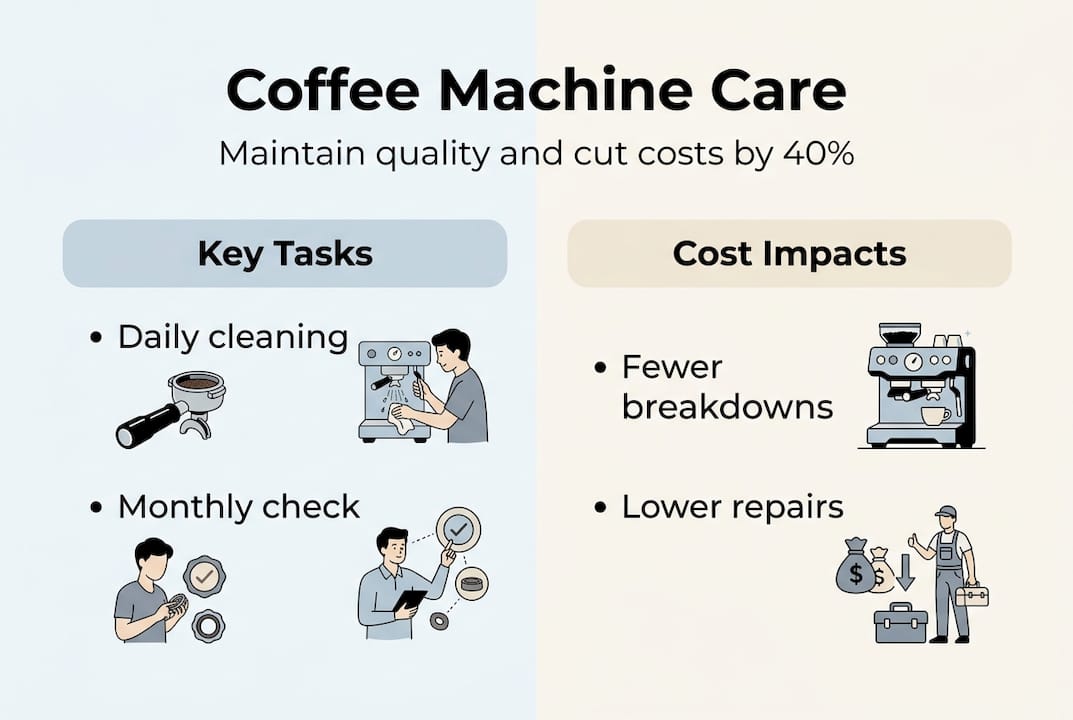
Start by mapping your daily output. High-volume use over 300 drinks per day requires professional servicing every 3 to 6 months, and preventive maintenance reduces costs by 40 to 60% compared to reactive repairs, while extending machine lifespan by 40 to 65%. Annual maintenance costs typically range from £200 to £1,000 when service plans are included. Those figures matter when you’re planning budgets and justifying investment to owners.
Consider the machine types for hospitality you currently operate. Bean-to-cup machines, traditional espresso machines, and filter brewers each have distinct maintenance requirements. A traditional espresso machine with group heads and steam wands needs far more hands-on daily attention than an automatic bean-to-cup unit.
Here’s a quick assessment checklist to complete before designing your workflow:
- Machine age and warranty status: Know when your next manufacturer service falls due
- Daily drink volume per machine: Track this for at least one full week
- Staff skill levels: Identify who can perform basic maintenance and who needs training
- Peak service windows: Note when machines are under maximum load
- Water hardness in your area: Hard water accelerates scale build-up significantly
- Existing service contracts: Review what’s already covered before duplicating effort
Use this data to build a tiered maintenance schedule. A venue with two machines running 400 drinks daily needs a more rigorous routine than one running 150. Review equipment options available to you if your current machines are ageing beyond cost-effective maintenance.
| Venue type | Daily volume | Recommended service frequency |
|---|---|---|
| Small café or deli | Under 100 drinks | Every 6 to 12 months |
| Mid-size restaurant or hotel | 100 to 300 drinks | Every 4 to 6 months |
| High-volume café or venue | Over 300 drinks | Every 3 to 4 months |
Essential maintenance tools and materials
Once you know what’s required for your machines and venue, assemble your maintenance kit. Having the right materials to hand is not a luxury; it’s the difference between a five-minute fix and a two-hour scramble through supplier catalogues mid-service.
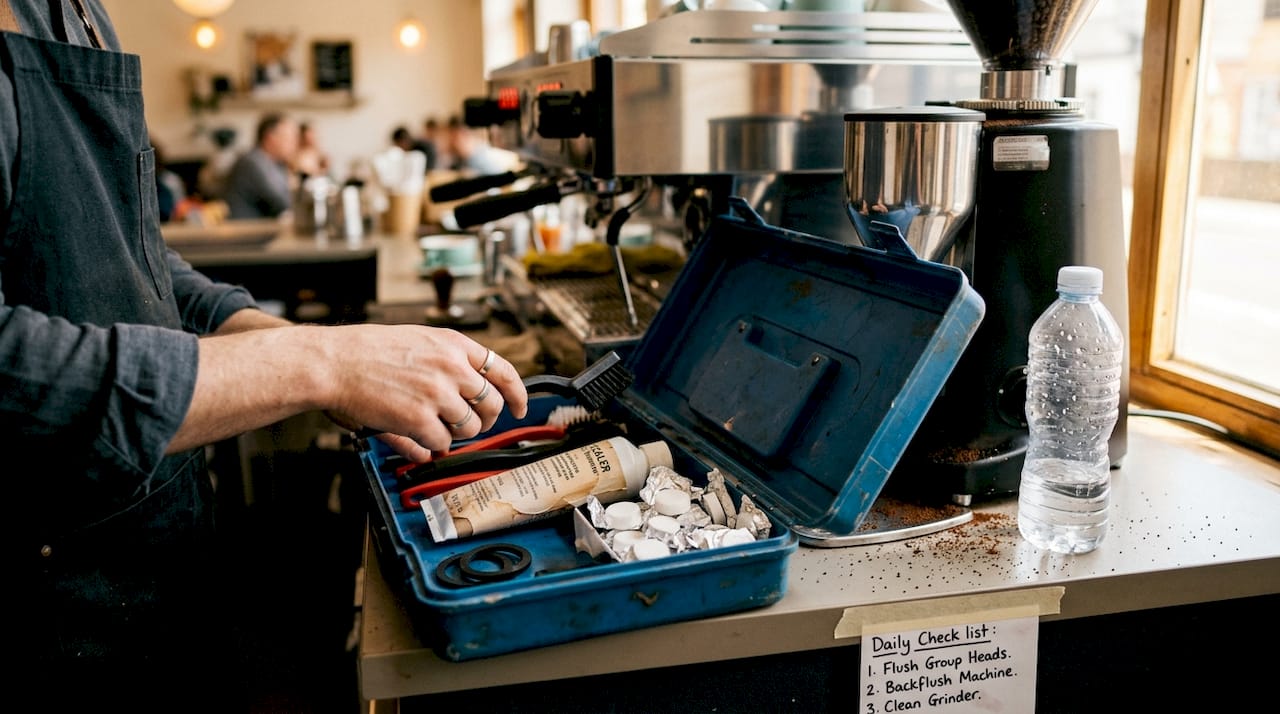
A well-stocked kit removes the excuse of “we didn’t have the right cleaner” or “the brush was missing.” Preventive maintenance reduces ongoing costs and downtime far more effectively than reactive fixes, and that starts with being prepared before problems arise.
Your core kit should include:
- Espresso machine cleaner tablets (backflush detergent for group heads)
- Descaling solution appropriate for your machine manufacturer’s recommendations
- Group head brushes in multiple sizes
- Microfibre cloths dedicated solely to machine cleaning
- Blind filter basket for backflushing
- Replacement gaskets and seals matched to your machine models
- Water filters and filter housings sized for your plumbing setup
- Maintenance log templates printed or digital, per machine
- Calibrated tamper and distribution tool for espresso quality checks
Review equipment checklists to ensure your kit aligns with current best practice for your specific machine types. For installation requirements or if you’re setting up a new station, setup service details can clarify what’s needed from day one.
| Item | Purpose | Replacement frequency |
|---|---|---|
| Cleaning tablets | Group head backflush | Daily use |
| Descaler | Scale removal from boiler | Monthly or as indicated |
| Group head gaskets | Prevent leaks at portafilter | Every 3 to 6 months |
| Water filter cartridge | Reduce scale and improve taste | Every 3 months or 500 litres |
| Maintenance log | Track all tasks and issues | Ongoing, never replace |
Pro Tip: Keep a locked, labelled kit box at each machine station. When every team member knows exactly where supplies are stored, cleaning tasks get done consistently, even during shift handovers when communication is rushed.
Step-by-step coffee machine maintenance workflow
With tools ready, implement a workflow that ensures reliability and quality across every service. A structured sequence removes guesswork and makes accountability straightforward.
Preventive maintenance reduces costs by 40 to 60% and extends machine lifespan by up to 65%, so the time invested in a proper routine pays back many times over. Here’s how to structure it:
Daily tasks (every shift):
- Backflush group heads with clean water after each service period
- Backflush with detergent tablet at end of day
- Wipe steam wands immediately after each use; purge before and after steaming
- Empty and rinse drip trays and knock boxes
- Wipe down machine exterior, portafilters, and baskets
- Check water level in reservoir if not plumbed in
- Log any unusual sounds, pressure drops, or temperature inconsistencies
Weekly tasks:
- Deep clean portafilter baskets by soaking in group head cleaner solution
- Inspect group head gaskets for wear or cracking
- Check and clean water filter housing
- Run a full descale cycle if water hardness is high
- Review maintenance log entries from the week and flag any recurring issues
Monthly and quarterly tasks:
- Replace water filter cartridge (monthly in hard water areas)
- Inspect and replace group head gaskets as needed
- Book professional engineer service if approaching the 3 to 6 month threshold
- Calibrate grinder settings and check dose consistency
Integrate these tasks directly into your staff shift checklists so they’re treated as non-negotiable operational duties, not optional extras. Explore maintenance contracts to supplement your in-house routine with scheduled professional visits. For a broader look at how structured support transforms daily operations, coffee support services offer a helpful framework.
“A maintenance log is your machine’s health record. Without it, you’re diagnosing problems blind.”
Pro Tip: Integrate the daily and weekly tasks into your opening and closing checklists on your POS or shift management system. When maintenance is embedded in the routine, it stops being something staff forget and starts being something they simply do.
Troubleshooting, verification, and compliance checks
After implementing the workflow, ensure ongoing performance with diligent checks and troubleshooting. Even the best routines encounter unexpected issues, and knowing how to respond quickly is what separates a minor inconvenience from a full service disruption.
Servicing high-volume machines reduces emergency repair costs and downtime, directly supporting customer satisfaction scores and repeat business. But between professional visits, your team needs to recognise and act on early warning signs.
Common faults and quick responses:
- Weak or watery espresso: Check grind size, dose weight, and tamping pressure before suspecting machine issues
- Slow extraction or blockage: Backflush immediately; inspect group head gasket for swelling
- Steam wand not producing pressure: Check boiler temperature setting; inspect steam tip for blockage
- Unusual grinding noise: Stop use and inspect grinder burrs for foreign objects or excessive wear
- Machine not reaching temperature: Check power supply, thermostat setting, and whether a descale is overdue
- Leaking portafilter: Replace group head gasket; this is the most common wear item in busy venues
After any maintenance task or fault resolution, verify the machine’s performance with a test extraction. Pull two shots and check yield, time, and visual quality before resuming service. Document the result in your maintenance log.
“If a fault recurs within 48 hours of a fix, escalate to a professional engineer. Repeated symptoms signal a deeper issue.”
For food hygiene compliance, ensure all cleaning products used are food-safe and that your logs are available for inspection. Many Environmental Health Officers now expect documented cleaning schedules for commercial beverage equipment. For further quality improvement tips and guidance on optimising coffee service, both resources offer practical, venue-specific advice.
Why most workflows fail hospitality managers and what actually works
Here’s an uncomfortable observation we’ve made working with venues across Devon and the wider southwest: most maintenance workflows fail not because managers don’t care, but because they’re designed by engineers, not hospitality people. They’re technically correct and practically ignored.
A checklist pinned to a stock room wall doesn’t survive a busy Saturday. What survives is a routine that’s been trained into your team, talked about in briefings, and reinforced with simple accountability. We’ve seen venues with ageing machines outperform newer competitors simply because their staff understood the equipment and took ownership of it.
The other gap is feedback. When a barista notices something unusual and has no clear way to flag it, the information dies with the shift. Build a simple reporting habit, even a verbal handover note or a WhatsApp message to the manager, and you’ll catch issues weeks before they become breakdowns.
Investing in barista training that includes machine care, not just coffee technique, changes the relationship your team has with the equipment. They stop seeing it as someone else’s problem and start treating it as their tool.
Enhance your operation with expert support and supplies
A strong in-house maintenance routine is the foundation, but pairing it with professional support is where real operational confidence comes from.
At The Coffee Factory, we work with hospitality and foodservice businesses across Devon and the southwest to provide wholesale services that go beyond coffee supply. Our maintenance contract options are designed to complement your daily workflow with scheduled professional care, reducing the risk of costly breakdowns. We also supply a full range of coffees including decaffeinated options to meet every guest’s preference. If you’d like to talk through how we can support your operation, get in touch with our team today.
Frequently asked questions
How often should a commercial coffee machine be serviced in high-volume venues?
For venues serving over 300 drinks per day, professional servicing is recommended every 3 to 6 months to prevent costly breakdowns and maintain consistent quality.
What are the cost benefits of preventive maintenance for hospitality coffee machines?
Preventive maintenance reduces costs by 40 to 60% compared to reactive repairs, making it the most financially sound approach for any commercial operation.
Which essential tools should every coffee machine maintenance kit include?
Your kit should contain descaler, group head brushes, cleaning tablets, spare gaskets and seals, water filter cartridges, and a dedicated maintenance log for each machine.
How does maintenance affect coffee taste and customer satisfaction?
Consistent maintenance ensures every extraction runs at the correct temperature and pressure, eliminating off-flavours caused by scale, old oils, or worn components, and keeping guests coming back.