
TL;DR:
- ‘Single origin’ lacks a regulated definition, varying from country to farm level.
- Authentic traceability requires direct sourcing, documentation, and transparency from suppliers.
- Quality depends on cupping scores and freshness, not just the ‘single origin’ label.
The term ‘single origin coffee’ appears on menus, wholesale catalogues, and packaging across the Southwest UK, yet surprisingly few people agree on what it actually means. There is no regulated definition of ‘single origin’ recognised by the Specialty Coffee Association (SCA), the International Coffee Organisation (ICO), or any trade body. For hospitality business owners, this ambiguity is more than an academic concern. It affects what you pay, what you serve, and how confidently you can tell your customers the story behind their cup. This guide cuts through the confusion and gives you the practical clarity you need.
Table of Contents
- Defining single origin coffee: Fact versus perception
- How is single origin coffee sourced?
- Quality benchmarks and price: Is single origin always premium?
- Single origin versus blends: Which suits hospitality venues?
- Expert perspective: Getting beyond the label in Southwest UK hospitality
- Enhance your hospitality offering with premium, traceable coffee
- Frequently asked questions
Key Takeaways
| Point | Details |
|---|---|
| No legal definition | Single origin coffee varies widely—always check exact sourcing details for transparency. |
| Traceability is vital | Direct relationships, farm information, and documentation ensure quality and ethical supply. |
| Premium price, not always superior | Single origin often costs more but isn’t automatically better than blends—seasonal and processing factors matter. |
| Hospitality menu balance | Blends offer reliability for staples; rotating single origins adds excitement and story value for customers. |
| Verify claims, don’t assume | Demand supplier transparency and use cupping or tasting before making procurement decisions. |
Defining single origin coffee: Fact versus perception
At its simplest, ‘single origin’ suggests coffee that comes from one place rather than a blend of multiple origins. But that definition stretches enormously in practice. A bag labelled ‘single origin Ethiopia’ might contain beans from dozens of smallholder farms across an entire country. Another labelled the same way might trace back to a single named farm, a specific lot, or even a single harvest day. The specificity varies from country-level to farm-level, which creates real potential for vague or misleading labelling.
This variability matters enormously when you are procuring coffee for a hotel, restaurant, or café. You may be paying a premium for a label rather than a verifiable story. Without a regulated standard, any roaster can use the term. That is why working with B2B coffee supply solutions that prioritise transparency is so important for hospitality venues in the Southwest.
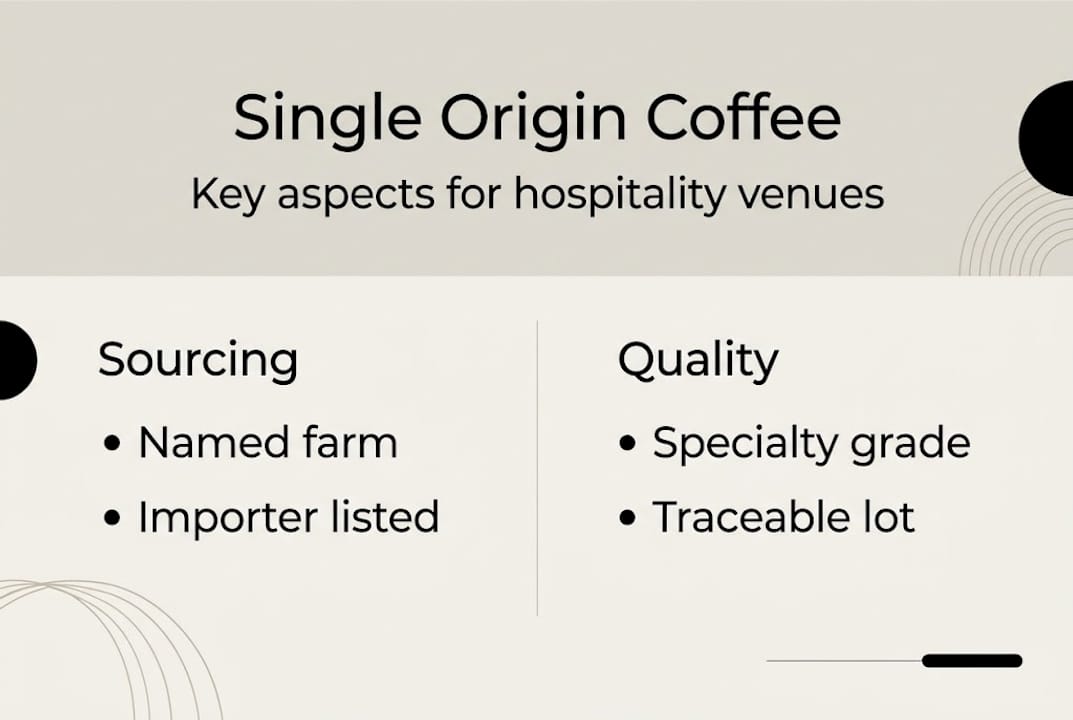
Here is how the levels of ‘single origin’ typically break down:
| Specificity level | What it means | Traceability |
|---|---|---|
| Country | Beans from one nation | Low |
| Region | Beans from one growing area | Medium |
| Farm or estate | Beans from one named farm | High |
| Lot or micro-lot | Specific harvest, block, or process | Very high |
The key takeaways for hospitality buyers:
- Country-level labelling tells you very little about quality or ethics.
- Farm or lot-level labelling gives you a genuine story to share with customers.
- Processing details (washed, natural, honey) add further depth to provenance.
- Roast dates confirm freshness, which directly affects flavour in the cup.
“Single origin is not a quality guarantee. It is a starting point for a conversation about provenance. The real value lies in how much detail sits behind the label.”
For hospitality owners, the practical lesson is this: ask more questions. A confident supplier will welcome them.
How is single origin coffee sourced?
Understanding what single origin means, we next explore how it is sourced to ensure traceable quality for your hospitality venue.
Responsible sourcing is where the real differentiation happens. The best UK roasters build direct relationships with farms, documenting altitude, variety, processing method, and harvest date at every stage. These details are not just marketing. They are quality assurance tools that allow roasters to replicate results and buyers to verify claims.
Here is what a robust sourcing chain typically involves:
- Direct trade or importer relationship with named farms or cooperatives.
- Documentation of harvest details: variety, altitude, processing method, and crop year.
- Sample roasting and cupping before committing to a full purchase.
- Consistent communication with the farm or importer across growing seasons.
- Third-party verification where possible, such as Rainforest Alliance or Fair Trade certification.
Emerging origin verification tools using geolocation and blockchain technology are beginning to give roasters and buyers even greater confidence in provenance claims. While these are not yet standard practice across the industry, they represent the direction of travel for serious specialty roasters.
| Sourcing method | Traceability | Typical cost impact | Common in UK? |
|---|---|---|---|
| Direct trade | Very high | Higher | Growing |
| Importer with documentation | High | Medium | Common |
| Commodity broker | Low | Lower | Less common in specialty |
For your venue, choosing a sustainable coffee wholesale partner means asking whether they can name the farm, the importer, and the harvest year. If the answer is vague, the provenance probably is too. Our guide to choosing coffee suppliers covers this in more detail, and our foodservice coffee guide explains what hospitality buyers should prioritise at every stage.
Pro Tip: When evaluating a new supplier, ask for the green coffee import documentation. A roaster who sources transparently will have it readily available and will be proud to share it.
Quality benchmarks and price: Is single origin always premium?
Now that sourcing is clear, let us analyse what certifies a coffee as ‘premium’, and whether single origin always deserves its reputation.
The SCA uses a cupping score system to define quality. Coffees scoring 80 or above qualify as specialty grade, with higher elevations typically producing more complex, nuanced flavours. In the UK, the Great Taste Awards offer a recognised consumer-facing benchmark, awarding one to three stars based on flavour excellence. These are the markers that genuinely indicate quality, not the single origin label itself.
| Quality indicator | What it measures | Relevance for hospitality |
|---|---|---|
| SCA cupping score 80+ | Specialty grade flavour profile | High: confirms cup quality |
| Great Taste Award (1-3 stars) | Flavour excellence, UK standard | High: resonates with customers |
| Elevation (1,200m+) | Bean density and complexity | Medium: supports premium pricing |
| Processing method | Flavour development | High: affects taste consistency |
Single origin coffees often command a significant price premium. Expect to pay roughly 15 to 25 GBP per 12oz for quality single origin versus 8 to 12 GBP for blends, reflecting limited yields and the cost of traceable sourcing. However, price alone is not proof of quality.
Key factors that genuinely affect quality in single origin:
- Seasonal variability: Harvests differ year on year. A coffee you loved last season may taste different this year.
- Processing consistency: Natural processed coffees can be unpredictable if not handled carefully.
- Roast freshness: Even the finest green coffee loses its character if roasted weeks before delivery.
- Storage conditions: Improper storage at origin or during transit degrades flavour before the bean reaches your grinder.
Attending professional coffee tasting events is one of the most effective ways to calibrate your palate and make informed procurement decisions. You can also explore practical steps for improving coffee quality across your venue to ensure every cup reflects the investment you make at the buying stage.
Single origin versus blends: Which suits hospitality venues?
Having discussed quality, let us weigh single origin against blends to help you match your offering to customer expectations.
This is one of the most practical decisions you will make for your coffee menu. Both have genuine strengths, and the best hospitality venues often use both strategically. Single origin excels for flavour exploration and traceability, while blends remain the preferred choice for reliability in high-volume espresso service.
| Factor | Single origin | Blend |
|---|---|---|
| Flavour complexity | High, terroir-driven | Balanced, consistent |
| Seasonal consistency | Variable | Stable year-round |
| Storytelling potential | Excellent | Limited |
| Espresso performance | Can be challenging | Optimised for espresso |
| Price point | Higher | More accessible |
| Customer familiarity | Growing | Established |
Here is a practical approach for hospitality venues:
- Use a quality blend as your house espresso. It will perform consistently across flat whites, lattes, and cappuccinos, regardless of seasonal harvest shifts.
- Introduce single origin as a rotating filter or batch brew option. This creates seasonal excitement and gives your team a story to tell.
- Feature single origin prominently on your menu with origin details, tasting notes, and the farm name where possible.
- Rotate origins every two to three months to keep the offering fresh and encourage repeat visits from curious customers.
- Train your staff on the story behind each origin so they can communicate it confidently at the counter.
Pro Tip: Rotating single origin coffees through your seasonal coffee specials programme is a proven way to drive repeat footfall and position your venue as a destination for coffee enthusiasts.
Blends are not a compromise. They are a craft in their own right. Many of the world’s most celebrated espresso coffees are blends, designed with precision to deliver a specific flavour profile every single day.
Expert perspective: Getting beyond the label in Southwest UK hospitality
Here is our honest take, shaped by years of working with cafés, hotels, and restaurants across Devon and the wider Southwest. The single origin label has become a marketing tool as much as a quality signal, and that is a problem for buyers who take it at face value.
We have seen hospitality venues pay premium prices for coffees labelled ‘single origin’ that offered no more traceability than a commodity blend. The label alone carries no ethical or quality guarantee. What matters is whether your supplier can name the importer, the farm, the processing method, and the roast date without hesitation.
Our advice: demand specifics. Cup the coffee before you commit. Rotate origins thoughtfully to build a menu narrative that genuinely resonates with your customers. And work with a roaster who treats transparency as a baseline, not a selling point. Coffee quality drives hospitality business success in a very direct way, and the venues that thrive are those that invest in real knowledge, not just appealing labels.
Enhance your hospitality offering with premium, traceable coffee
If this article has prompted you to look more critically at your current coffee supply, that is exactly the right instinct. At The Coffee Factory, we work with hospitality venues across Devon and the Southwest to provide freshly roasted, traceable coffee with the support to match.
Our wholesale coffee services cover everything from supply contracts to equipment. We offer barista training for your staff so your team can communicate provenance and quality with genuine confidence. And as a family-run roastery committed to responsible sourcing, being an eco-friendly supplier is central to everything we do. Get in touch and let us help you build a coffee offering your customers will return for.
Frequently asked questions
Is single origin coffee better than blends for hospitality venues?
Single origin is ideal for flavour discovery and storytelling, but blends offer greater consistency for busy venues. Many successful venues use both strategically.
How can hospitality owners verify the traceability of single origin coffee?
Ask suppliers for farm or importer names, processing details, and roast dates, then use cupping to verify quality before committing to a supply contract.
Does the single origin label guarantee ethical or sustainable practices?
No. The label carries no ethical guarantee on its own. Only transparent sourcing, direct trade relationships, and verifiable documentation offer real assurance.
What is the typical price difference between single origin and blend coffees?
Single origin typically costs 15 to 25 GBP per 12oz compared to 8 to 12 GBP for blends, reflecting limited yields and the higher cost of traceable sourcing.