
Inconsistent coffee quality and unreliable supply are two of the fastest ways to lose repeat business in the Southwest UK’s competitive hospitality market. A guest who receives a flat, stale espresso on a busy summer morning in Devon is unlikely to return, and word travels quickly in tourist-heavy regions. The good news is that with the right approach to bean selection, supplier relationships, and contract flexibility, you can build a coffee programme that delivers consistent quality, protects your margins, and keeps both locals and visitors coming back. This guide walks you through every step, from defining your needs to monitoring ongoing performance.
Table of Contents
- Defining your coffee needs: business-focused requirements
- Selecting bean types and quality: sourcing for flavour and reliability
- Supplier selection: flexibility, contracts, and emergency service
- Ensuring ongoing quality and profitability: monitoring and adaptation
- Discover reliable coffee solutions for your hospitality business
- Frequently asked questions
Key Takeaways
| Point | Details |
|---|---|
| Assess business-specific needs | Define your volume, menu offerings, and customer type before choosing beans. |
| Choose reliable local suppliers | Select roasters with flexible contracts and emergency delivery in Southwest UK. |
| Balance quality and profitability | Match bean flavour and cost margins to achieve consistent taste and strong returns. |
| Monitor and adapt | Regularly check coffee quality, review pour costs, and refine your bean selection. |
Defining your coffee needs: business-focused requirements
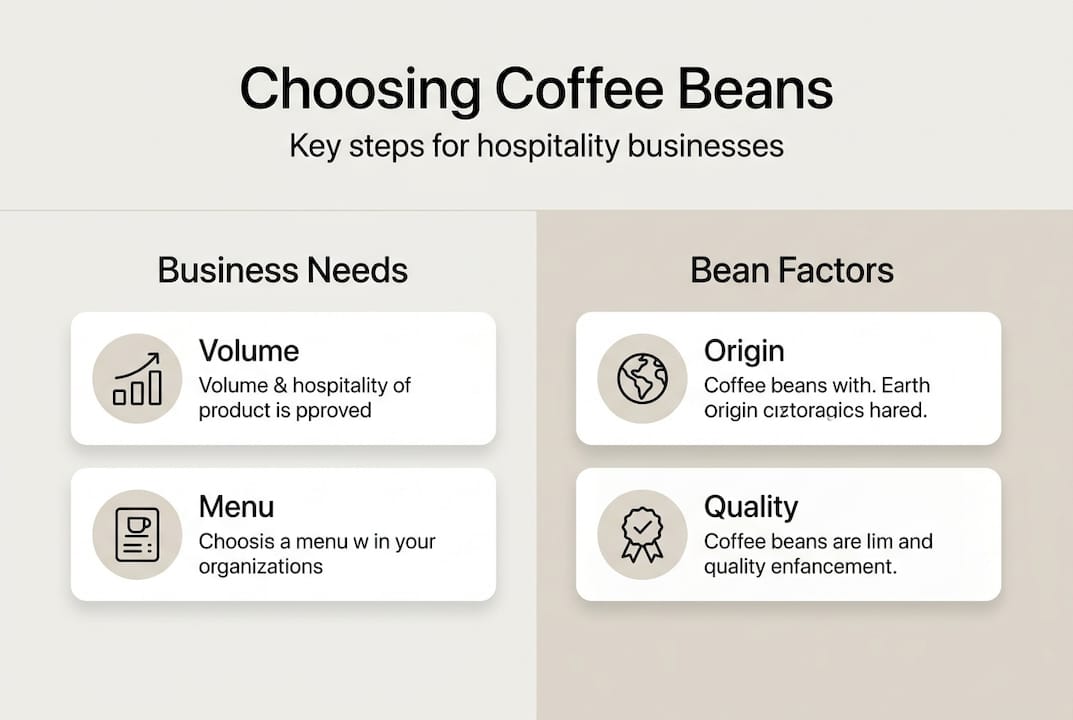
Before you order a single bag of beans, you need a clear picture of what your business actually demands from its coffee programme. Volume, service style, and customer expectations all shape the right choice, and getting this wrong from the start is an expensive mistake.
Start by calculating your daily and seasonal demand. A coastal café in Cornwall serving 200 covers on a July afternoon has very different needs from a city-centre hotel in Exeter running a quiet breakfast service in January. Consider whether your operation leans on drip filter, espresso-based drinks, or both, and whether takeaway cups account for a significant share of your output.
Here are the key factors to map out before approaching any supplier:
- Daily volume: Average cups served per day across peak and off-peak periods
- Service format: Espresso bar, filter station, bean-to-cup machine, or a combination
- Customer segment: Tourist trade, local regulars, corporate guests, or a mix
- Menu price points: Your bean cost must align with what you charge and what your customers expect
- Seasonal fluctuations: Summer peaks, event-driven spikes, and quiet winter months
Aligning bean choice with your menu pricing is critical. Pour cost benchmarks for drip coffee typically sit at 8 to 15% of the menu price, with espresso-based drinks commanding higher margins at £4 to £7 per cup. Knowing these numbers before you negotiate with a supplier puts you in a far stronger position.
Working with local Devon suppliers also gives you the advantage of shorter lead times and more responsive communication, which matters enormously when you are managing a busy service. Before committing to any agreement, review coffee contract clarity to understand what terms protect your business.
Pro Tip: Build a simple comparison table that maps your expected bean cost per cup against your menu price and target margin. This single exercise often reveals whether a premium single-origin bean is genuinely viable or whether a well-crafted blend delivers better commercial value.
| Coffee type | Approx. bean cost per cup | Typical menu price | Estimated margin |
|---|---|---|---|
| Drip filter | £0.10 to £0.20 | £2.50 to £3.50 | 75 to 85% |
| Espresso-based | £0.20 to £0.40 | £3.00 to £5.00 | 80 to 90% |
| Specialty single origin | £0.40 to £0.70 | £4.50 to £7.00 | 75 to 85% |
Selecting bean types and quality: sourcing for flavour and reliability
With your business needs outlined, the next step is matching bean types and quality to your operational realities. Flavour is important, but so is the ability to receive consistent, reliable stock week after week.
Here is a practical framework for evaluating your options:
- Blends vs single origin: Blends are formulated for consistency. A well-designed espresso blend will taste the same in February as it does in August, regardless of harvest variations. Single-origin beans offer distinctive flavour profiles that appeal to specialty coffee customers, but supply can be more variable and seasonal.
- Espresso roast vs filter roast: Espresso roasts are developed to perform under pressure, producing a balanced, full-bodied shot. Filter roasts are lighter and more nuanced, designed to shine in slower brewing methods. Using the wrong roast in the wrong application is a common and costly error.
- Freshness and roast date: Freshly roasted beans, ideally used within four to six weeks of roasting, produce noticeably better results. This is where local roasters hold a genuine advantage over large national distributors.
- Ethical sourcing: Customers increasingly notice and value sustainability credentials. Choosing beans with Rainforest Alliance, Fairtrade, or direct-trade provenance supports your brand story and appeals to environmentally conscious guests.
“Southwest UK businesses benefit from working with local roasters who understand regional demand patterns and can respond quickly to supply needs. Roasters like The Coffee Factory, alongside others in the region, provide the kind of responsive, relationship-driven service that national suppliers simply cannot match.”
Exploring a coffee blends overview helps you understand which profiles suit your menu and customer base. And if your trade fluctuates with the seasons, reviewing seasonal coffee specials can add genuine excitement to your offering without disrupting your core supply.

Supplier selection: flexibility, contracts, and emergency service
After narrowing down your flavour and bean preferences, the choice of supplier can make or break your coffee programme. A great bean sourced from an unreliable supplier is a liability, not an asset.
For hospitality businesses in the Southwest UK, flexible supply is non-negotiable. Tourism-driven demand means your order volumes in July can be three or four times higher than in November. A supplier who cannot accommodate that without penalties or delays will cost you money and stress.
Key features to look for in a commercial coffee supplier:
- Next-day or rapid delivery: Essential for avoiding stock-outs during busy periods
- Penalty-free volume changes: The ability to scale orders up or down without financial consequences
- Emergency response: A clear process for urgent supply needs or equipment issues
- Transparent contracts: No hidden clauses around minimum orders or exit terms
- Sustainability credentials: B Corp status, environmental commitments, or ethical sourcing policies
Pro Tip: Always request a trial contract before committing to a long-term agreement. Ask for references from other hospitality businesses in your region and specifically ask about how the supplier handled a supply problem or an unexpected demand spike.
| Supplier type | Contract flexibility | Emergency delivery | Local knowledge | Sustainability focus |
|---|---|---|---|---|
| Local Devon roaster | High | Yes, often same day | Strong | Typically strong |
| Regional distributor | Medium | Variable | Moderate | Variable |
| National wholesaler | Low | Rarely guaranteed | Limited | Inconsistent |
Reviewing your coffee contract clarity options before signing anything is time well spent. If equipment is part of the package, understanding your emergency repair service entitlements is equally important. And if you are still weighing up your options, comparing local Devon suppliers side by side gives you a grounded starting point.
Ensuring ongoing quality and profitability: monitoring and adaptation
Once you have established a relationship with your supplier, continuous monitoring ensures lasting quality and business growth. Many hospitality operators make the mistake of treating coffee as a set-and-forget category. It is not.
Here is a structured approach to ongoing quality management:
- Regular taste testing: Conduct a simple blind tasting of your espresso and filter coffee at least once a month. Involve your baristas. They are closest to the product and often notice quality shifts before anyone else.
- Batch auditing: When a new delivery arrives, check the roast date and compare the aroma and grind consistency against your benchmark. Reject batches that fall outside your agreed specification.
- Supplier review meetings: Schedule a quarterly conversation with your supplier to discuss performance, upcoming seasonal needs, and any product changes. Good suppliers welcome this dialogue.
- Customer feedback loops: Monitor reviews, comment cards, and direct feedback for coffee-specific mentions. A pattern of comments about bitter or weak coffee is a signal to act on immediately.
Statistic: Pour cost benchmarks for drip coffee sit at 8 to 15% of menu price. If your costs are creeping above this range, it is time to renegotiate your supply terms or review your menu pricing.
Common mistakes that erode coffee quality and profitability over time:
- Failing to monitor roast dates on incoming stock
- Ignoring seasonal shifts in customer taste preferences
- Sticking to rigid contracts that prevent you from responding to market changes
- Overlooking equipment maintenance, which directly affects extraction quality
Exploring innovative coffee menu ideas can help you stay ahead of customer expectations. Reviewing your environmental commitment as a business also strengthens your brand positioning. And if your equipment is holding back your coffee quality, looking at coffee equipment options could be the most impactful change you make this year.
Discover reliable coffee solutions for your hospitality business
Putting these insights into practice starts with finding a supplier who genuinely understands the Southwest UK hospitality landscape. At The Coffee Factory, we have spent years working alongside cafés, hotels, restaurants, and foodservice businesses across Devon and beyond, building coffee programmes that hold up under pressure.
Our wholesale services overview covers everything from flexible contracts and premium freshly roasted blends to sustainability-led sourcing and emergency supply support. Whether you are looking to explore our full coffee blends overview or find the right decaffeinated options for your evening service, we are here to help you build something you are proud to serve. Let’s get brewing.
Frequently asked questions
What is the best way to ensure reliable coffee supply for a busy hospitality venue?
Choose a local roaster with flexible contracts and emergency delivery guarantees. In tourist-heavy regions like the Southwest UK, a supplier who can scale with your seasonal demand is far more valuable than one offering a marginally lower unit price.
How do I calculate my coffee bean requirements for peak and off-season?
Estimate your average daily customer count, apply your historic sales data to forecast seasonal changes, and build in a buffer of around 15 to 20% for unexpected demand spikes. Seasonal demand planning is especially important for coastal and rural venues with strong summer trade.
Are there specific contract terms to look out for when choosing a commercial coffee bean supplier?
Look for contracts that allow penalty-free volume changes and include clear commitments on delivery timescales and emergency support. Avoid agreements that lock you into fixed monthly minimums with no flexibility for quiet periods.
How can I maintain consistent coffee quality as my business grows?
Regularly review supplier batches, conduct monthly taste tests with your team, and adapt your bean or blend choice based on customer feedback and sales patterns. Consistency comes from active management, not passive ordering.
What are typical pour cost benchmarks for commercial coffee beans?
For drip coffee, pour costs average 8 to 15% of the menu price. For espresso-based drinks, margins remain strong due to premium pricing, typically £3 to £5 per cup, making espresso one of the highest-margin items on any hospitality menu.