
Choosing a coffee supplier feels straightforward until you sit down to sign a contract. Many hospitality and foodservice operators assume it is simply a matter of selecting a bag of beans and agreeing a price per kilo. In reality, a well-structured coffee supply agreement touches everything from equipment and maintenance to staff training and delivery schedules. Getting it right can meaningfully reduce your operating costs, protect your quality standards, and give your team the support they need to serve consistently great coffee every single day.
Table of Contents
- Deciphering coffee contracts in hospitality
- Types of coffee contract models
- Pricing benchmarks and pour cost: What to expect
- Ethical sourcing and direct trade: Adding value
- Negotiating for Southwest UK hospitality: Local, stability, and sustainability
- Global benchmarks: Coffee ‘C’ futures and their impact
- Get tailored coffee supply for Southwest UK hospitality
- Frequently asked questions
Key Takeaways
| Point | Details |
|---|---|
| Contracts are bundled | Coffee supply contracts generally include beans, machine rental, maintenance, and training, saving time and hassle. |
| Choose the right contract model | Fixed, cost-plus and royalty contracts suit different business types; matching the model to your venue improves profitability. |
| Price benchmarks guide margins | Benchmark costs and pour percentages help hospitality venues control expenses and protect margins. |
| Ethical sourcing adds value | Direct trade and certified origin documents boost customer satisfaction and offer market differentiation. |
| Local and sustainable wins | Partnering with local roasters and negotiating multi-year terms ensures stability and quality for Southwest UK venues. |
Deciphering coffee contracts in hospitality
A coffee supply contract is far more than a purchase order. For hospitality and foodservice businesses, coffee supply contracts typically bundle beans, roasting, equipment leasing, maintenance, and training services into long-term agreements spanning anywhere from 3 to 60 or more months, often with machine rental tied to exclusive bean purchase. That bundled structure is actually a strength, not a constraint.
When everything sits under one agreement, you deal with a single point of contact for faults, deliveries, and training. There is no finger-pointing between a separate equipment company and your bean supplier when the grinder plays up on a busy Saturday morning. Working with regional suppliers in Devon adds another layer of reliability, because local roasters can respond quickly and personally in ways that national distributors simply cannot match.
A typical bundled contract covers:
- Green bean sourcing and roasting to your agreed profile
- Equipment rental or lease, including espresso machines and grinders
- Preventative maintenance and breakdown cover
- On-site barista training for new and existing staff
- Scheduled delivery with agreed lead times
- Dedicated account support from a named contact
Pro Tip: Always ask your supplier to specify the response time for equipment breakdowns within the contract itself. A 24-hour response clause can save you thousands in lost revenue during a busy service period.
Types of coffee contract models
Now that you know what a contract covers, it helps to understand the different pricing and service structures available. Borrowing from the broader catering sector, contract models include fixed-price, cost-plus, nil-subsidy, per-head, and royalty arrangements, with incentivised fees tied to service level agreements (SLAs) for performance.
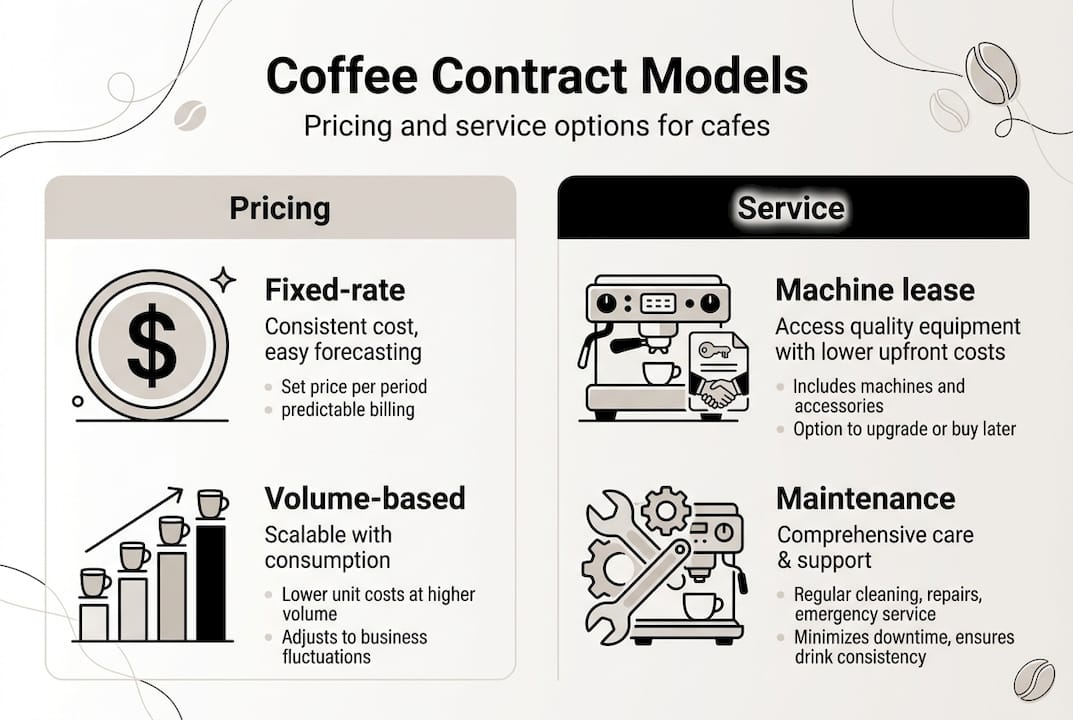
Here is a quick comparison of the most common models:
| Contract model | How it works | Best suited for |
|---|---|---|
| Fixed-price | You pay a set rate regardless of volume | Predictable, high-volume venues |
| Cost-plus | Supplier costs plus an agreed margin | Transparent, trust-based partnerships |
| Nil-subsidy | No subsidy; full cost passed to buyer | Independent cafes and restaurants |
| Per-head | Charged per customer or cover | Hotels and event caterers |
| Royalty | Percentage of coffee sales paid to supplier | Franchise or branded concepts |
SLAs are worth paying close attention to. They set measurable performance targets, such as delivery accuracy, machine uptime, and training frequency, and can include financial incentives or penalties. When reviewing coffee contract pricing, push for SLA clauses that protect your service standards rather than just your bean price.
To choose the right model, work through these steps:
- Calculate your average monthly coffee volume in kilograms.
- Estimate your peak and off-peak trading periods.
- Decide how much pricing predictability you need for budgeting.
- Assess whether you want equipment included or prefer to own your machines.
- Confirm whether exclusivity clauses align with your menu and brand identity.
Pricing benchmarks and pour cost: What to expect
Understanding pricing benchmarks helps you negotiate from a position of knowledge rather than guesswork. Wholesale bean benchmarks sit at £12 to £25 per kg for specialty coffee and £20 to £40 or more per kg for premium single-origin lots, with a pour cost target of 8 to 15%, equating to roughly £0.25 to £0.50 per 12oz cup. Direct trade sourcing can lift customer satisfaction by 10 to 15%.
| Coffee type | Wholesale price per kg | Target pour cost |
|---|---|---|
| Specialty blend | £12 to £25 | 8 to 12% |
| Premium single-origin | £20 to £40+ | 10 to 15% |
| Decaf specialty | £15 to £28 | 8 to 13% |
Pour cost is the ratio of your bean cost to the retail price of the finished drink. If a flat white sells for £3.50 and the beans cost £0.35 to produce it, your pour cost is 10%. Keeping this figure within the 8 to 15% range leaves room for milk, labour, and overhead while protecting your margin.
Key factors that influence your cost per cup:
- Grind consistency: A well-calibrated grinder reduces waste significantly.
- Dose accuracy: Even a 0.5g overdose per shot adds up across hundreds of covers.
- Milk steaming discipline: Milk is often a bigger cost driver than beans in espresso-based drinks.
- Menu engineering: Featuring optimised coffee margins on your highest-selling drinks protects overall profitability.
If you serve a significant volume of decaf, it is worth reviewing decaf bean rates separately, as decaf specialty lots often carry a premium that can skew your blended pour cost upward.
Ethical sourcing and direct trade: Adding value
Ethical sourcing is no longer a marketing add-on. It is increasingly a purchasing expectation among consumers across the Southwest UK. Direct trade and ethical sourcing cut intermediaries, improve traceability, and can lift customer satisfaction by 10 to 15%, though they require careful verification of documents such as the ICO Certificate of Origin (COO).
“Traceability is the new quality signal. Guests who know where their coffee comes from trust the cup more.”
The ICO COO is a key document. It confirms the country of origin and helps you verify that the coffee in your contract matches the story you tell your guests. A hybrid importer model, where your roaster works with a mix of direct trade and established importers, can balance the risk of supply disruption while still giving you strong provenance credentials.
Practical benefits of ethical sourcing for your venue:
- Storytelling material for menus, social media, and staff briefings
- Differentiation from competitors using commodity-grade coffee
- Staff pride in serving coffee with a clear, positive supply chain
- Guest loyalty built on shared values around sustainability
Working with an eco-friendly supplier that prioritises responsible sourcing means you inherit those credentials without having to build them from scratch. Our Devon roasted coffee is sourced with traceability in mind, so you always know the story behind the cup.
Pro Tip: Ask your supplier for the ICO COO for each origin in your blend. If they cannot provide it, that is a signal worth noting before you sign a long-term agreement.
Negotiating for Southwest UK hospitality: Local, stability, and sustainability
Negotiating a coffee contract in the Southwest UK carries some distinct advantages if you know how to use them. Prioritising local roasters, such as those based in Devon, delivers fresher beans, faster response times, and a sustainability story that resonates with regional guests. With C-price volatility up 110% since 2024, multi-year contracts with local suppliers offer meaningful protection against market swings.
Here is how to approach the negotiation table with confidence:
- Lead with volume: Share your monthly usage data upfront. Suppliers reward commitment with better rates.
- Request a freshness guarantee: Ask for roast-to-delivery windows, ideally within 5 to 10 days of roasting.
- Use sustainability as leverage: Suppliers with strong environmental commitments are often willing to formalise those commitments in writing.
- Negotiate review clauses: Build in annual pricing reviews tied to the C-price index rather than accepting open-ended rate increases.
- Secure training provisions: Ensure barista training is included and scheduled, not just promised verbally.
- Clarify exit terms: Understand the notice period and any equipment return obligations before you sign.
Locality is a genuine negotiating asset. A Devon-based roaster can visit your site, understand your service style, and adjust your blend profile in ways that a remote national supplier simply cannot replicate.
Global benchmarks: Coffee ‘C’ futures and their impact
Even if you never trade a futures contract yourself, understanding the ICE Coffee ‘C’ futures market gives you context for why your bean prices move. The Coffee ‘C’ contract covers 37,500 lbs of Arabica coffee, priced in cents per pound, with physical delivery and a transition underway toward metric ton contracts. Premiums and discounts vary by origin, with Colombia typically attracting a premium of around 1,000 points above the ‘C’ price, while Brazil often trades at a discount of around 600 points below it.
| Origin | Typical differential vs ‘C’ price |
|---|---|
| Colombia | +1,000 points (premium) |
| Brazil | -600 points (discount) |
| Ethiopia | Variable, often premium |
| Vietnam (Robusta) | Separate exchange (LIFFE) |
For UK hospitality, the practical implication is straightforward. When the ‘C’ price spikes, as it has done sharply since 2024, your supplier’s raw material costs rise. Understanding this helps you interpret coffee supply pricing conversations with your roaster and negotiate review clauses that are fair to both sides rather than simply absorbing unexpected increases.
Get tailored coffee supply for Southwest UK hospitality
Armed with a clear understanding of contract structures, pricing benchmarks, and sourcing principles, the next step is finding a supplier who can deliver on all of them. At The Coffee Factory, we work with cafes, hotels, restaurants, and offices across Devon and the wider Southwest to build contracts that genuinely fit your business.
From flexible machine rental options and a carefully curated range of coffee blends to hands-on barista training for your staff, we bring everything under one roof so you can focus on running your venue. We are a family-run roastery rooted in Devon, and we take pride in building long-term partnerships rather than just processing orders. Let’s get brewing together.
Frequently asked questions
What should a hospitality coffee contract include?
A coffee contract should cover beans, equipment leasing, maintenance, training, and service terms, usually in a bundled package. Long-term agreements of 3 to 60 or more months are standard, often with machine rental tied to exclusive bean purchase.
How does direct trade improve customer experience?
Direct trade sourcing can boost customer satisfaction by up to 15% by improving traceability and reinforcing ethical quality credentials that guests increasingly value.
What is a typical pour cost for hospitality coffee?
The pour cost target for UK hospitality venues is 8 to 15%, which typically works out at around £0.25 to £0.50 per 12oz cup depending on your blend and retail price.
How can I ensure contract stability amid price volatility?
Negotiating multi-year terms with a local roaster provides greater supply stability and fresher beans, particularly given that C-price volatility has risen by 110% since 2024.
What are coffee ‘C’ futures and should we pay attention?
Coffee ‘C’ futures set the global Arabica pricing benchmark that directly influences contract rates and origin premiums, making them a useful reference point for any UK hospitality buyer reviewing or renegotiating supply agreements.