
The coffee served in your café or hotel is not the same product sitting on a supermarket shelf. It never was. Foodservice coffee is purpose-built for commercial environments, engineered for volume, consistency, and cost control in ways that retail packs simply cannot match. For hospitality operators across the Southwest UK, getting this distinction right is the difference between a guest who returns and one who quietly leaves a disappointing review. This guide walks you through the key definitions, the economics of bulk supply, brewing at scale, quality trade-offs, and the practical steps that will sharpen your coffee operation from the ground up.
Table of Contents
- Defining foodservice coffee in hospitality
- The economies of bulk: How foodservice supply really works
- Brewing at scale: Consistency and equipment know-how
- Quality versus scale: Foodservice coffee blends and sustainability
- Practicalities and pitfalls: Best practices for SW UK hospitality
- Reliable local coffee supply for SW UK hospitality
- Frequently asked questions
Key Takeaways
| Point | Details |
|---|---|
| Foodservice coffee is different | It’s produced, packed, and distributed for commercial scale and consistency, not retail consumers. |
| Bulk buying saves money | Ordering in larger quantities cuts per-kg costs, improves storage efficiency, and reduces waste. |
| Equipment and training matter | Reliable brewing needs the right machines and barista skills for consistent, high-quality coffee. |
| Sustainability is a selling point | Ethical sourcing and local partnerships have a direct impact on guest satisfaction and loyalty. |
Defining foodservice coffee in hospitality
To understand why you cannot just use supermarket coffee in your café or hotel, let us clarify what foodservice coffee actually means and why it is so different from what you see on supermarket shelves.
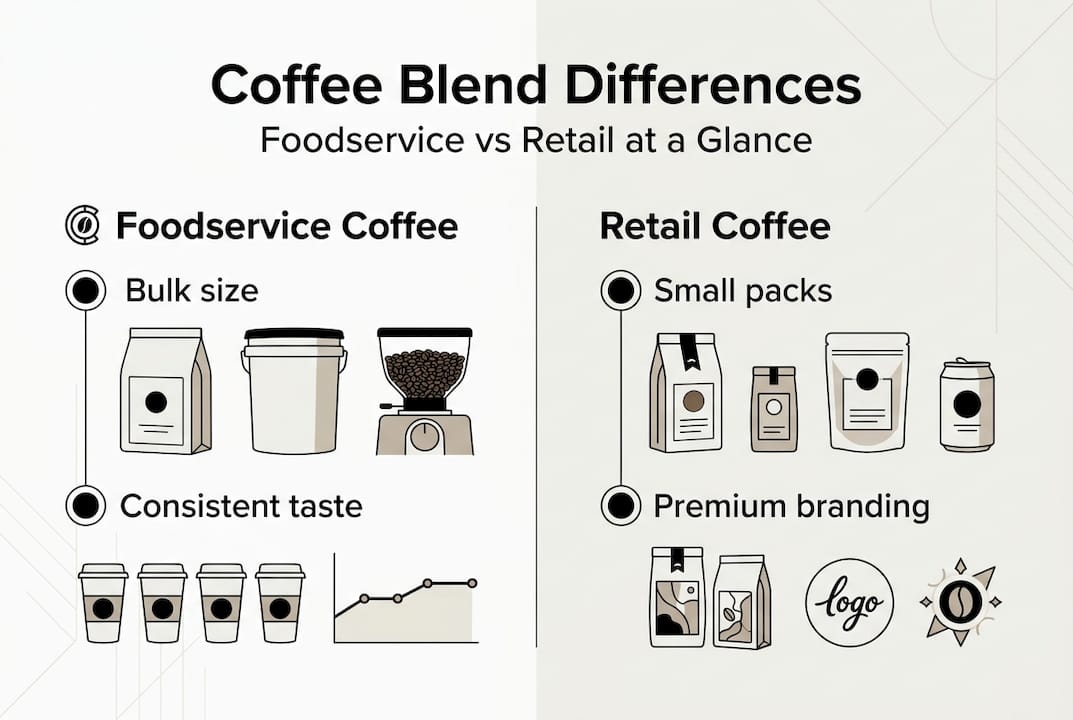
Foodservice coffee refers to coffee products specifically designed, packaged, and supplied for use in commercial hospitality settings. This is not a minor packaging tweak. The blends, roast profiles, grind specifications, and bag sizes are all calibrated for the demands of a food service environment, where speed, repeatability, and margin control are non-negotiable.
Retail coffee is built for the home consumer: small bags, premium branding, and a price point that reflects individual convenience. Foodservice coffee flips every one of those priorities. Here is how the two compare:
| Feature | Retail coffee | Foodservice coffee |
|---|---|---|
| Packaging size | 200g to 1kg | 1kg to 400kg+ |
| Primary focus | Flavour experience | Consistency and cost |
| Target user | Home consumer | Hospitality operator |
| Price per kg | Higher unit cost | Lower at volume |
| Shelf life labelling | Consumer-facing | Trade and bulk formats |
For Southwest UK operators, the practical benefits are immediate. Bulk formats reduce packaging waste, simplify stock rotation, and cut the cost per cup served. Our bulk packaging options are designed with exactly these pressures in mind.
Key distinctions worth remembering:
- Blend construction: Foodservice blends are engineered for machine compatibility and batch repeatability, not single-cup artistry.
- Labelling: Trade packs carry different compliance information suited to commercial kitchens.
- Delivery cadence: Foodservice supply runs on scheduled, reliable delivery cycles rather than ad hoc retail purchasing.
The economies of bulk: How foodservice supply really works
Once you recognise foodservice coffee’s unique definition, it is critical to grasp how the economics and logistics of bulk supply underpin everything from your profit margins to daily operations.
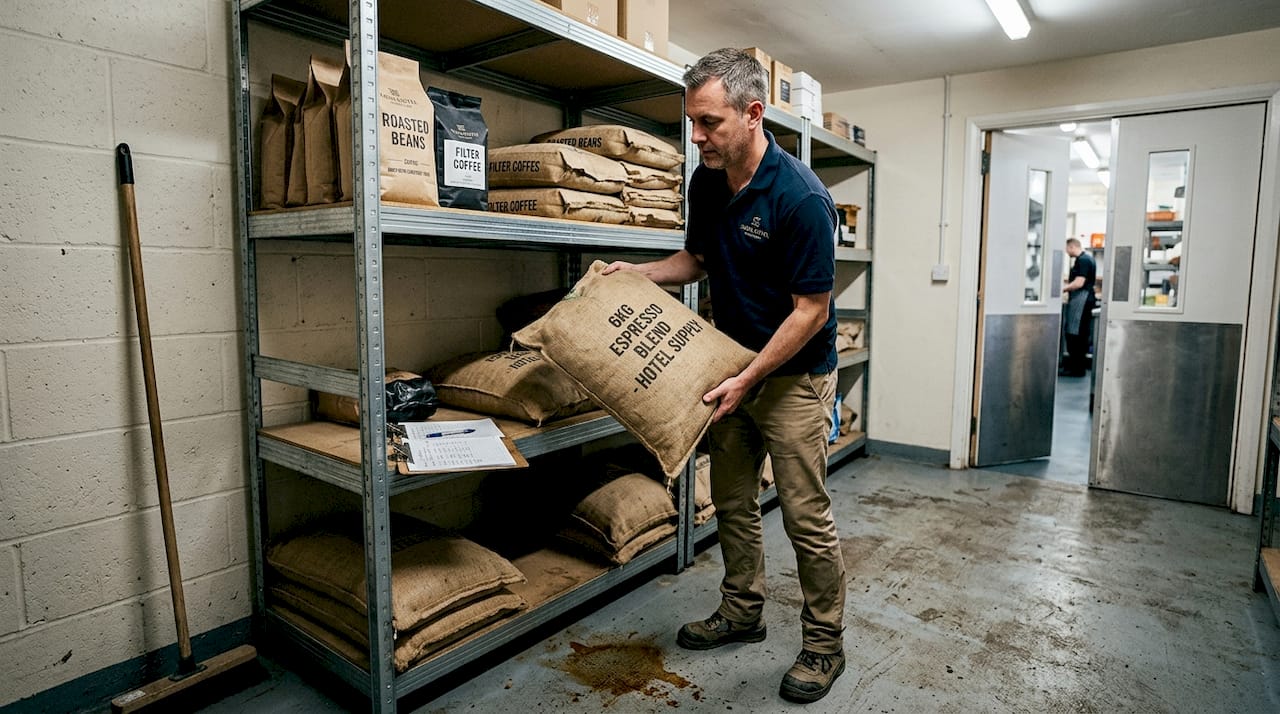
Bulk foodservice coffee comes in large industrial sizes, from 6kg bags through to pallets of 40 to 400kg, delivering cost-efficiency, reduced waste, and reliable supply for high-volume brewing. The savings are real. Commercial price points typically range from £9 to £32 per kg depending on quality tier, and operators ordering at pallet scale can achieve savings of up to 30% compared with smaller order quantities.
| Order volume | Approx. cost per kg | Best suited for |
|---|---|---|
| 1 to 5kg | £28 to £32 | Small cafés, trial orders |
| 6 to 25kg | £18 to £27 | Mid-size restaurants, hotels |
| 25kg+ | £9 to £18 | High-volume venues, groups |
Storage is where many operators stumble. Large volumes demand discipline: cool, dry conditions away from direct light, strict first-in-first-out (FIFO) rotation, and a clear understanding of your roast-to-use window. Freshness degrades faster than most people expect once a large bag is opened.
For guidance on choosing suppliers who can match your volume and delivery needs, it is worth reviewing what a reliable business coffee supply partnership actually looks like in practice. Our coffee bags and pods range covers multiple volume tiers to suit different operation sizes.
Pro Tip: Always confirm your supplier’s minimum order quantity and delivery frequency before committing. For Southwest UK operators, a local roastery with a short supply chain will almost always outperform a national distributor on freshness and responsiveness.
Brewing at scale: Consistency and equipment know-how
With the supply side managed, the next challenge becomes ensuring every cup meets expectations, no matter how many you serve in a day.
Commercial brewing at scale demands bulk roasting for consistency across large batches, precise grind sizes for commercial machines, and brewing methodologies like drip, batch brewing, or bean-to-cup systems tailored to high-volume output. A busy hotel breakfast service may need to produce 30 or more cups per hour without any drop in quality. That is not achievable with domestic equipment or inconsistent grind settings.
Here is a practical sequence for locking in consistency:
- Define your roast specification with your supplier so every delivery matches the same profile.
- Set grind size precisely for your specific machine type, whether espresso, batch brewer, or bean-to-cup.
- Calibrate equipment regularly, checking dose weight, extraction time, and brew temperature at least weekly.
- Clean all equipment daily, including grinders, group heads, and brew baskets, to prevent flavour contamination.
- Document your settings so any member of staff can replicate the same result every time.
Exploring your coffee equipment options is a sensible early step, and understanding the full range of coffee machine types will help you match the right system to your service style. For venues already operating equipment, reviewing reliable coffee equipment benchmarks can highlight where upgrades would pay off fastest.
Pro Tip: Invest in a commercial grinder with large flat burrs. They produce a more uniform grind particle size, which translates directly into faster, more consistent extraction during rush periods.
Southwest UK operators often favour medium-dark roast profiles for batch brewing methods. These profiles hold up well across longer brew cycles and deliver the bold, rounded cup that guests in this region tend to prefer.
Quality versus scale: Foodservice coffee blends and sustainability
Consistency and reliability are vital, but quality and provenance increasingly shape guest satisfaction and brand reputation.
The honest trade-off in foodservice blending is this: large-scale commercial blends typically combine lower-grade Arabica with Robusta for cost control and crema stability, while trusted brands drive guest recommendations at rates of 61 to 75%. Premium single-origin coffees are rare in true bulk foodservice supply, though specialty-focused roasteries are beginning to bridge that gap.
For Southwest UK hospitality businesses, working with a local roastery offers a genuine competitive edge. Shorter supply chains mean fresher coffee, lower food miles, and the ability to tailor a blend specifically to your machine and your guests’ palate. That is something a national distributor simply cannot replicate.
Sustainability is no longer optional. 79% of hotel guests in the UK prefer ethically sourced coffee, making certification a genuine commercial differentiator rather than a marketing afterthought. Understanding the differences between specialty and commercial coffee can help you position your offering more confidently.
Key sustainability credentials to look for when sourcing foodservice coffee:
- Fairtrade certification: Guarantees minimum prices and community investment for producers.
- Rainforest Alliance: Focuses on environmental and social standards across the supply chain.
- Organic certification: Relevant for venues targeting health-conscious guests.
- Direct trade relationships: Increasingly valued by guests who want genuine provenance stories.
- Carbon-conscious roasting: A growing differentiator, particularly in the Southwest where environmental values run strong.
Our environmental commitment and coffee blends overview outline how we approach these standards for our trade partners.
Practicalities and pitfalls: Best practices for SW UK hospitality
Moving from theory to practice, let us focus on the steps to get your foodservice coffee setup right and avoid costly errors specific to UK hospitality operators.
Bulk coffee storage requires strict cool and dry conditions, FIFO rotation, and careful monitoring of shelf life to protect quality and manage volatile bean prices. Getting this wrong is one of the most common and avoidable sources of waste in hospitality kitchens.
Steps for effective coffee storage in a Southwest UK hospitality setting:
- Store all coffee in a cool, dry area away from heat sources, steam, and direct sunlight.
- Keep bags sealed until needed and use airtight containers once opened.
- Apply FIFO rotation strictly: oldest stock always moves first.
- Label every container with the roast date and expected use-by window.
- Review stock levels weekly to avoid over-ordering and unnecessary waste.
Common mistakes that cost operators money and reputation:
- Ordering too much at once without the storage capacity to maintain freshness.
- Using the wrong grind for your specific equipment, which kills extraction quality.
- Skipping staff training, which leads to inconsistent cups regardless of coffee quality.
- Ignoring sustainability credentials, which increasingly affects guest perception and loyalty.
- Switching suppliers without trialling the new product with your team and guests first.
For SW UK hospitality operators, partnering with local roasters, focusing on bulk savings, and investing in barista training are the three pillars of reliable, guest-pleasing coffee service. Our barista training programme is designed specifically for hospitality teams, and our supplier guidance helps you ask the right questions before you commit. Reviewing coffee supply best practices is a useful starting point for any operator reviewing their current setup.
Pro Tip: Before switching to a new blend or supplier, run a two-week trial with your front-of-house team and gather informal guest feedback. Small adjustments at this stage are far less disruptive than a full switch after you have committed to volume.
Building a reputation for local provenance and sustainability is a genuine growth lever in the Southwest. Guests here are increasingly discerning, and a well-told coffee story, backed by real credentials, adds tangible value to your brand.
Reliable local coffee supply for SW UK hospitality
If this guide has clarified what foodservice coffee really involves, the next step is finding a supply partner who can deliver on every level: quality, consistency, sustainability, and local knowledge.
We are a family-run Devon roastery with deep roots in the Southwest hospitality scene. Our wholesale service options cover tailored blends, flexible volume tiers, and scheduled delivery within a 60-mile radius. We also offer on-site barista training for your team and hold strong environmental credentials that your guests will notice and appreciate. Whether you are setting up a new café, reviewing your hotel’s breakfast coffee, or simply looking for a more reliable roastery partner, we would love to talk. Get in touch for a local quote or a sample, and let’s get brewing.
Frequently asked questions
How is foodservice coffee different from regular retail coffee?
Foodservice coffee is packaged in bulk, prioritises consistency and cost, and is designed for commercial brewing, unlike retail coffee aimed at home consumers.
What packaging sizes are most common for foodservice coffee?
Bulk bags from 6kg to pallet loads of 40 to 400kg are common, ensuring cost savings and efficiency for high-volume venues.
Why does consistency matter in hospitality coffee?
Consistency ensures guests have a reliable experience, which is crucial for reviews and repeat business. Bulk roasting for consistency and tailored brewing methodologies make this achievable at scale.
Is sustainability important when choosing foodservice coffee?
Absolutely. 79% of hotel guests in the UK prefer ethically sourced coffee, making sustainability a vital decision factor for any hospitality operator.