
TL;DR:
- Consistent coffee quality depends on reliable systems, staff training, and proper equipment maintenance.
- Partnering with knowledgeable suppliers and implementing routine protocols ensures guest loyalty and quality.
- Regular staff training, equipment care, and supplier support are essential for long-term coffee excellence.
One substandard cup of coffee can quietly undo months of hard work building guest loyalty. For café and hotel owners across the Southwest UK, inconsistent coffee quality is one of the most damaging yet fixable problems in daily operations. Guests notice. They talk about it. And they often don’t return. The good news is that with the right approach, covering everything from staff knowledge and equipment care to supplier partnerships and daily routines, you can build a coffee programme that consistently impresses and keeps guests coming back. This guide walks you through every practical step.
Table of Contents
- Identifying the barriers to consistent coffee quality
- Essential tools and supplier support for reliable coffee
- Establishing a foolproof coffee preparation routine
- Maintaining quality with ongoing equipment care
- Why most hospitality coffee upgrades fail—and how to get it right
- Expert Southwest UK coffee solutions—your next step
- Frequently asked questions
Key Takeaways
| Point | Details |
|---|---|
| Supplier partnerships | The right local supplier offers more than beans—they provide training, equipment, and ongoing support to guarantee quality. |
| Consistent routines | Daily, weekly, and monthly habits for preparation and cleaning are essential for reliable coffee and business success. |
| Staff training | Investing in ongoing barista training pays off with better guest experiences and higher standards over time. |
| Maintenance matters | Proper machine maintenance prevents most breakdowns and ensures every cup meets guests’ expectations. |
| Sustainability drives loyalty | Offering sustainable coffee can increase repeat customers as many UK guests now factor it into their choices. |
Identifying the barriers to consistent coffee quality
Before you can fix a problem, you need to name it clearly. Most hospitality venues don’t struggle with coffee because they’ve chosen the wrong beans. They struggle because the systems around those beans are unreliable. Understanding where the gaps actually sit is the essential first move.
Staff turnover is one of the most disruptive forces in hospitality coffee quality. When experienced team members leave, their knowledge walks out with them. A new hire without proper training will produce inconsistent results even with premium equipment and excellent beans. Research shows that untrained staff undermine premium beans and equipment, and that a guest’s intellectual experience of coffee, understanding origins and flavour notes, drives advocacy far more than sensory pleasure alone. That’s a significant insight for any venue serious about loyalty.
Equipment issues are another silent quality killer. A grinder that hasn’t been calibrated, a steam wand that’s partially blocked, or a machine running at the wrong temperature will produce poor results regardless of what goes in the hopper. Many venues only address equipment problems reactively, after complaints, rather than through scheduled maintenance.
Ingredient choices matter enormously too. Using the wrong blend for your water type, skipping a water filter, or grinding too coarse or too fine will consistently undermine results. These are fixable mistakes, but only once they’re identified.
Common barriers to consistent quality include:
- Inconsistent staff training with no structured refresher programme
- Poor equipment maintenance leading to temperature and pressure inconsistencies
- Wrong grind settings or stale beans used past their optimal window
- No standard recipe cards for staff to reference during service
- Unfiltered or hard water affecting extraction and machine longevity
“The difference between a good coffee venue and a great one often comes down to what happens before the first cup is pulled each morning, not the beans themselves.”
When choosing coffee beans for your venue, consider how they interact with your water, your equipment, and your team’s skill level. Similarly, choosing coffee suppliers who understand your specific operational context makes a significant difference to how these barriers are addressed from day one.
Essential tools and supplier support for reliable coffee
Knowing what undermines good coffee, it’s time to assemble the right tools and support. Equipment and ingredients are only part of the picture. The supplier relationship you build around them is equally important.
Every reliable commercial coffee setup needs a core set of tools:
- Commercial espresso machine with consistent temperature and pressure stability
- Burr grinder calibrated daily to match bean freshness and roast date
- Water filtration system matched to your local water hardness
- Steam wand kept clean and purged before each use
- Cleaning kit including backflush detergent, group head brushes, and milk frother cleaner
Beyond hardware, the supplier relationship is where many Southwest UK venues find their greatest competitive advantage. Specialist coffee suppliers offering expert consultancy, staff training, equipment maintenance, and consistent quality control give you a genuine operational edge. This is not simply about buying beans; it’s about having a knowledgeable partner invested in your success.
Local roasters are particularly valuable here. Working with a Devon-based roastery means freshly roasted coffee arrives at its peak, and your supplier understands the regional context of your business. Sustainability credentials are increasingly important too: sustainability boosts loyalty among 70% of UK consumers who factor ethical sourcing into their choices. Aligning with a supplier who prioritises eco-friendly sourcing strengthens your offering to environmentally conscious guests.
| Tool or service | Why it matters | Frequency of use |
|---|---|---|
| Commercial espresso machine | Core extraction consistency | Daily |
| Calibrated burr grinder | Grind precision and freshness | Daily |
| Water filtration system | Protects machine and improves taste | Ongoing |
| Supplier training sessions | Keeps staff skills current | Quarterly |
| Equipment maintenance visits | Prevents costly breakdowns | Quarterly |
Pro Tip: Schedule a quarterly review with your coffee supplier to assess blend performance, refresh staff training, and check equipment calibration. This one habit prevents most quality drift before guests ever notice it.
Establishing a foolproof coffee preparation routine
With the right equipment and supplier support, implementing the perfect routine comes next. A consistent routine is what separates venues that occasionally produce great coffee from those that do it reliably, every shift, every day.
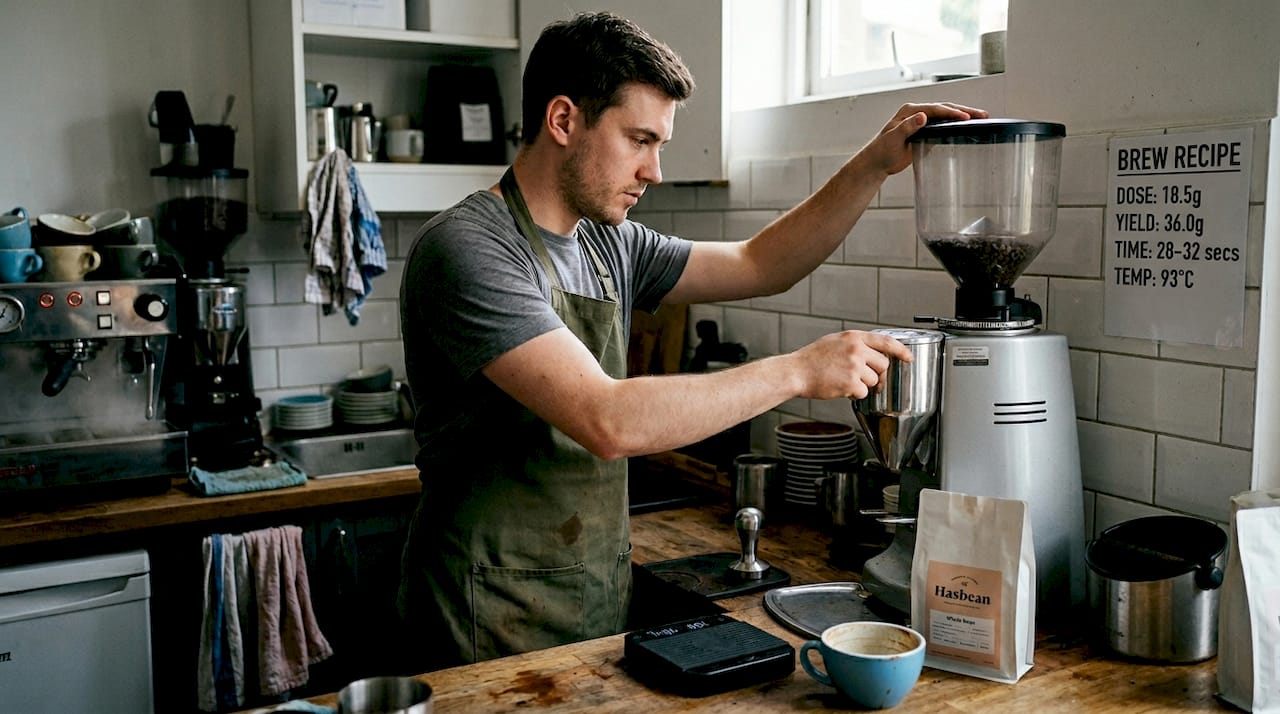
Research confirms that consistent barista training is vital, and that staff who understand coffee origins and flavour profiles create guests who advocate for your venue rather than simply enjoying a drink. That knowledge starts with structured daily practice.
Here is a practical preparation routine for your team:
- Daily opening: Flush the group heads, purge the steam wand, check grind settings against the recipe card, and pull a test shot before service begins.
- During service: Wipe steam wand after every use, check dose and yield every 30 minutes, and taste espresso periodically to catch any drift.
- Daily closing: Backflush the machine, clean group heads thoroughly, empty and rinse drip trays, and refill the bean hopper for the morning.
- Weekly: Deep clean the grinder burrs, descale the steam wand, and review any guest feedback relating to coffee.
- Monthly: Full machine descale (or more frequently in hard water areas), water filter check, and a team calibration session.
| Routine element | Specialty coffee approach | Commodity coffee approach |
|---|---|---|
| Grind calibration | Daily, adjusted per roast date | Weekly or ad hoc |
| Recipe card use | Mandatory for every shift | Optional |
| Staff tasting sessions | Regular and structured | Rare or absent |
| Supplier engagement | Ongoing partnership | Transactional only |
Pro Tip: Involve your team in regular coffee tastings where they compare different extraction variables. Staff who understand why a shot tastes bitter or sour will self-correct far more reliably than those following instructions without context. Our barista training courses are designed specifically to build this kind of practical, curious knowledge. For a broader view of how expertise translates to business results, our master coffee expertise guide is worth exploring.
Maintaining quality with ongoing equipment care
Flawless preparation depends on machinery being reliable, and here’s how to make sure it always is. Equipment care is the unglamorous backbone of every consistently excellent coffee programme, and the venues that treat it as an afterthought pay for it in both reputation and repair costs.
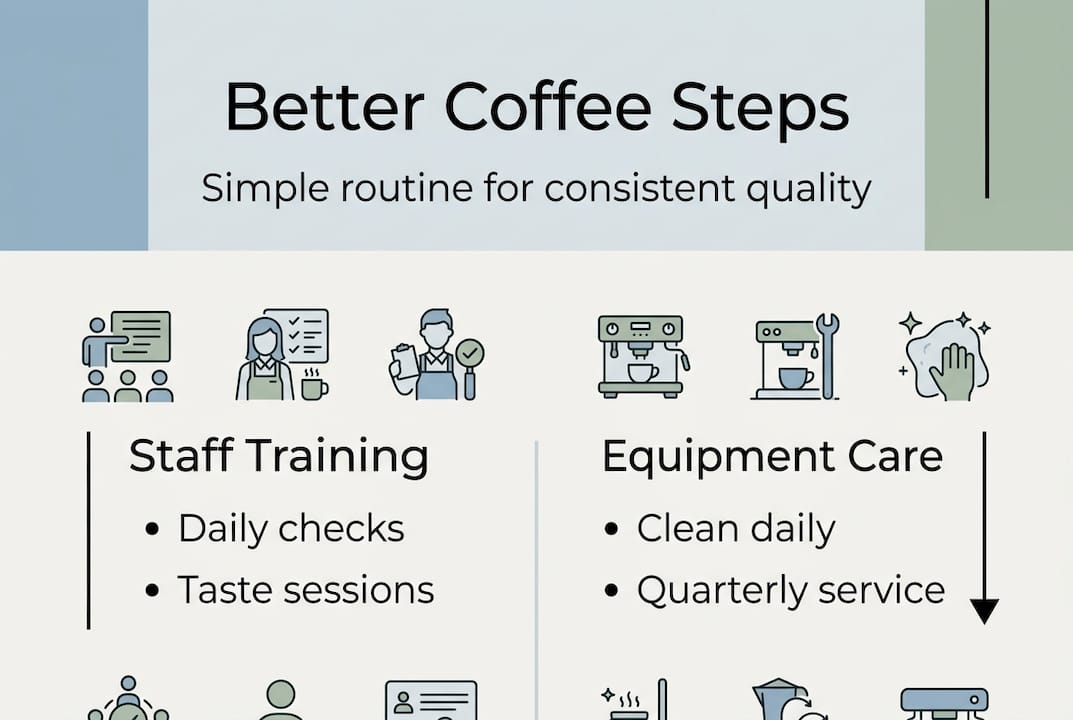
The numbers are stark: 83% of equipment failures in hospitality can be prevented with proper maintenance, and descaling should happen every two to four weeks in hard water areas like much of the Southwest. That single statistic should reshape how you think about maintenance budgets.
Here is a structured maintenance schedule:
- Daily: Backflush with water, purge the steam wand, empty drip trays, and wipe all external surfaces.
- Weekly: Deep clean group heads with backflush detergent, clean grinder burrs, and inspect portafilter baskets for blockages.
- Monthly: Full descale of the boiler and group heads, check and replace water filter cartridge if needed, and inspect steam wand tip.
- Quarterly: Book a professional service visit to inspect internal components, calibrate pressure and temperature, and replace worn seals or valves.
| Maintenance task | Frequency | Risk if skipped |
|---|---|---|
| Backflushing | Daily | Bitter flavour, blocked group head |
| Steam wand cleaning | Daily | Milk residue, hygiene risk |
| Full descale | Monthly | Scale build-up, machine failure |
| Professional service | Quarterly | Undetected faults, costly repairs |
“Equipment maintenance should never be an afterthought. With 83% of failures entirely preventable, a simple schedule protects your investment, your reputation, and your guests’ experience.”
The financial case is straightforward. A professional service visit costs a fraction of an emergency repair or machine replacement. More importantly, a machine that breaks mid-service creates a guest experience failure that no apology can fully recover. Explore maintenance planning options and review coffee equipment examples to understand what a well-supported setup looks like in practice.
Why most hospitality coffee upgrades fail—and how to get it right
Here’s what most guides don’t warn you about. Hospitality owners often invest in better beans or a new machine and then feel frustrated when the improvement doesn’t stick. The reason is almost always the same: they changed one component without changing the system around it.
We’ve seen this pattern repeatedly. A venue upgrades to a premium single-origin blend but keeps the same undertrained staff and the same unserviced grinder. The result is expensive beans producing mediocre coffee. The upgrade didn’t fail because the beans were wrong. It failed because the surrounding culture and process hadn’t moved.
Real, lasting improvement comes from treating coffee as a discipline rather than a product. That means building staff curiosity through ongoing learning, embedding recipe discipline into daily operations, and treating your supplier as a genuine partner rather than just a delivery service. The benefits of premium coffee are only realised when the whole system supports them.
Pro Tip: Run a quarterly “coffee quality challenge” with your team. Set measurable targets around consistency, guest feedback scores, and extraction accuracy. Make it engaging and reward progress. Venues that build this culture see sustained improvement rather than short-lived gains after each equipment purchase.
Expert Southwest UK coffee solutions—your next step
If this guide has shown you where the gaps in your coffee programme might be, the most effective next step is working with a specialist who understands your regional context and your business goals.
We work with cafés, hotels, and restaurants across Devon and the wider Southwest, providing tailored blends, on-site barista training courses, equipment support, and the kind of ongoing partnership that keeps quality consistent long after the first delivery. Our hospitality coffee solutions are built around your specific operation, not a generic package. From coffee equipment options to maintenance contracts and freshly roasted blends, we’re here to make excellent coffee the easiest part of your day. Let’s get brewing.
Frequently asked questions
What is the fastest way to improve coffee quality in a café or hotel?
Partnering with a local specialist supplier for immediate staff training and equipment review delivers rapid, measurable quality improvements without requiring a full operational overhaul.
How often should commercial coffee machines be professionally serviced?
Quarterly professional servicing is recommended, with monthly descaling in hard water areas to prevent the 83% of failures that proper maintenance can avoid.
Does sourcing sustainable coffee really affect guest loyalty?
Yes, sustainability influences loyalty for 70% of UK coffee consumers, making ethical sourcing a genuine commercial consideration rather than simply a values statement.
Is specialty coffee always the best option for hospitality businesses?
Not always. Some guests value predictability over complexity, and specialty versus commodity coffee choices should reflect your specific guest profile and venue style rather than trend alone.