
TL;DR:
- Coffee cupping standardizes quality assessment, enabling better menu and supplier choices.
- Regular blind tastings build staff expertise and improve guest experience.
- Investing in coffee tasting offers a competitive edge, increasing loyalty and revenue.
Most hospitality managers choose coffee the same way they choose a supplier: on price, familiarity, or a well-designed bag. It’s a reasonable starting point, but it leaves real money on the table. Professional coffee tasting, known as cupping, is the structured sensory evaluation that roasters have used for decades to assess quality, and it’s now one of the sharpest tools available to ambitious venue managers across the South West. Used well, it transforms how you select beans, train staff, and shape the guest experience. This guide covers the SCA protocol, real-world applications, and practical steps to run tasting events that genuinely improve your coffee menu.
Table of Contents
- What is coffee tasting (cupping) and why does it matter for businesses?
- Inside the SCA protocol: mechanics, scoring, and how objective is coffee tasting?
- Real-world impact: case studies and practical benefits for South West UK hospitality
- Advanced tips, recent changes, and avoiding common pitfalls
- Why coffee tasting is still underused—and what most hospitality managers miss
- Enhance your hospitality coffee with expert support
- Frequently asked questions
Key Takeaways
| Point | Details |
|---|---|
| Coffee tasting is essential | Professional cupping drives better coffee choices and guest experience. |
| SCA protocols add value | Following industry standards helps remove guesswork and bias from buying decisions. |
| Practical events boost menus | Regular tasting sessions shape more tailored, high-performing coffee menus. |
| Expertise turns into profit | Investing in tasting and staff training directly impacts repeat business and margins. |
What is coffee tasting (cupping) and why does it matter for businesses?
Now that you know coffee tasting isn’t just for roasters, let’s explore exactly how it works and why it matters for your business.
Coffee tasting for businesses, known as coffee cupping, is a standardised sensory evaluation protocol primarily following the SCA (Specialty Coffee Association) methodology. The SCA is the global body that sets quality standards across the coffee industry, and their cupping protocol gives everyone in the supply chain a shared language for describing and scoring what’s in the cup.
Originally, cupping was the domain of green coffee buyers and roasters. Today, forward-thinking hotels, restaurants, and cafés use it for quality control, menu development, staff training, and smarter purchasing. If you’ve ever wondered how coffee pros evaluate taste, the answer is a disciplined, repeatable process that removes guesswork entirely.
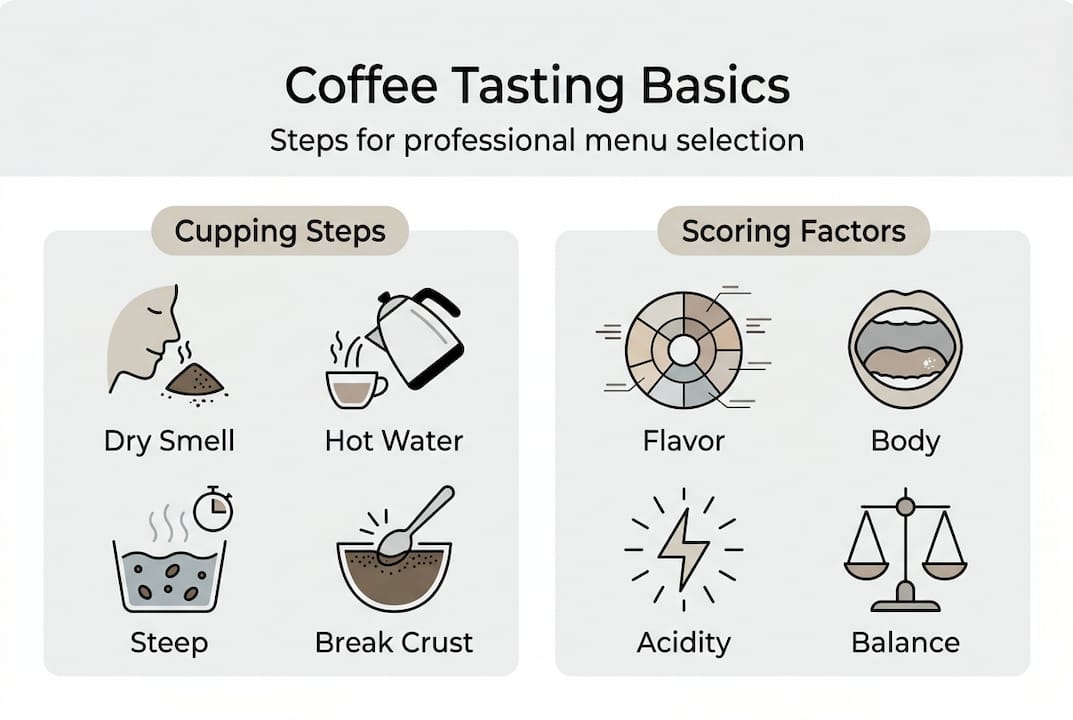
During a cupping session, trained tasters assess a range of attributes:
- Fragrance and aroma: the dry and wet smell of freshly ground and brewed coffee
- Flavour: the overall taste impression, from fruity and floral to nutty or chocolatey
- Aftertaste: the quality and duration of flavour after swallowing
- Acidity: the brightness or liveliness in the cup, often described as citric or malic
- Body: the weight and texture of the coffee on the palate
- Balance: how well all attributes work together without one dominating
- Uniformity and sweetness: consistency across multiple cups and the presence of natural sugars
“Cupping gives your team an objective framework to evaluate coffee, rather than relying on gut instinct or supplier persuasion. That objectivity is where better menus begin.”
For venue managers, the practical value is clear. You can use cupping to compare beans from different origins, evaluate new seasonal offerings, or assess whether your current house blend still meets your quality standard. Knowing what equipment is needed for tasting is the first step to making it a regular part of your operation.
A tailored coffee selection, built on tasting rather than assumption, resonates with guests. It signals craft, care, and confidence in your product.
Inside the SCA protocol: mechanics, scoring, and how objective is coffee tasting?
Understanding what cupping is, let’s break down the cupping session steps and see how scoring guides better choices.
A standard SCA cupping session follows a precise sequence. Here’s how it works in practice:
- Grind the coffee to a medium-coarse consistency and assess the dry fragrance immediately
- Add water at 93°C directly onto the grounds, filling each cup to the prescribed level
- Steep for four minutes without stirring, allowing a crust to form on the surface
- Break the crust by pushing it gently with a spoon, inhaling the released aroma
- Skim the surface to remove foam and grounds before tasting begins
- Slurp the coffee using a cupping spoon, aerating it across the palate to assess all attributes
- Score each attribute on the SCA form as the coffee cools, noting how flavour evolves
The core cupping steps follow a strict sequence of dry fragrance, adding 93°C water, steeping for four minutes, breaking the crust, and then evaluating multiple attributes as the cup cools.
Scoring uses the SCA 100-point scale, where coffees scoring 80 or above qualify as specialty grade. The scale covers each attribute individually before combining into a final score. Q-grading, a formal certification programme, uses this same methodology, though SCA is now transitioning toward a new system called CVA (Coffee Value Assessment).
| Score range | Classification | Typical use |
|---|---|---|
| 90 to 100 | Outstanding | Rare, prestige menus |
| 85 to 89 | Excellent | Premium café and hotel offerings |
| 80 to 84 | Specialty | Core hospitality menu |
| Below 80 | Commercial grade | Bulk or commodity use |
Blind cupping, where tasters don’t know which coffee they’re evaluating, reduces bias and improves calibration across your team. It’s particularly useful when comparing your current supplier against alternatives. Increasing staff expertise through regular blind sessions builds confidence and a shared vocabulary that strengthens your entire coffee operation.
Pro Tip: Use the SCA flavour wheel during every session. It standardises language so your team describes “bright citrus acidity” rather than simply “sharp,” making purchasing conversations with suppliers far more productive.
Real-world impact: case studies and practical benefits for South West UK hospitality
With the protocol clear, it’s time to look at the real-world business impact of tasting events for your venue.
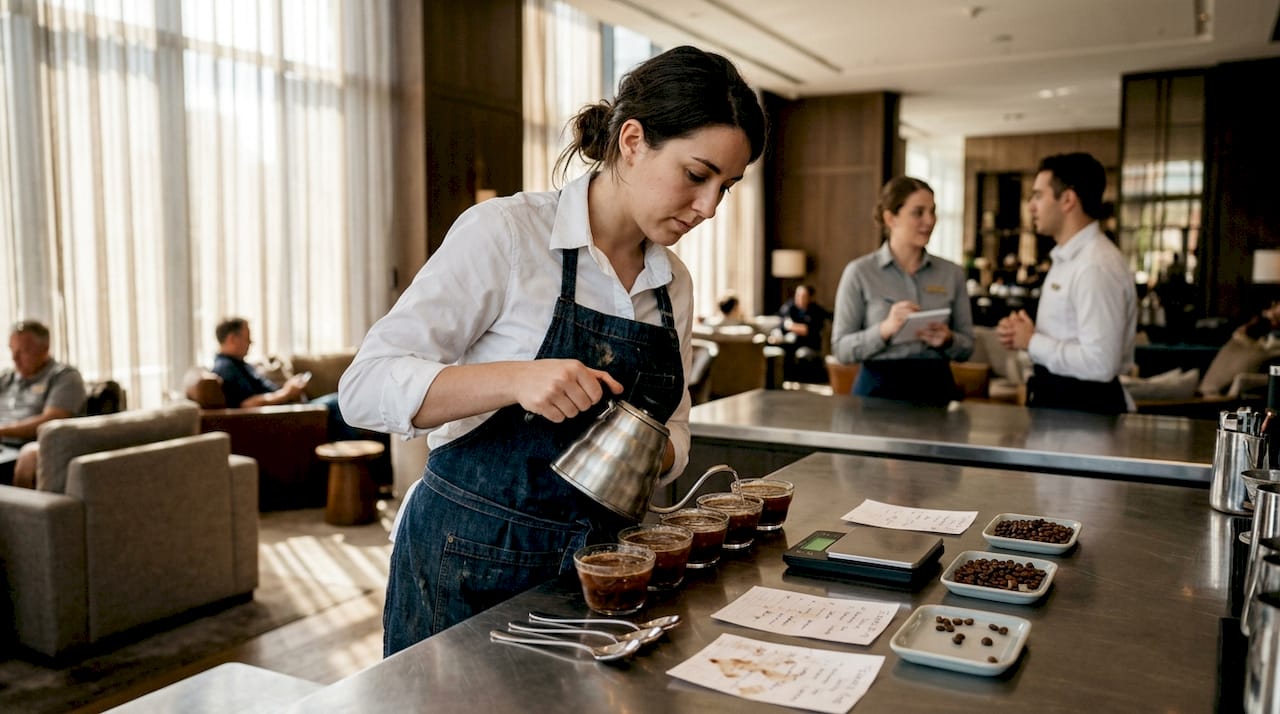
A Devon hotel introduced quarterly cupping events two years ago, working with a local roaster to evaluate seasonal single-origin coffees alongside their house blend. The result was a refined menu that matched their guest profile precisely, with a lighter, fruit-forward filter option added for morning service and a richer, full-bodied espresso blend retained for afternoon and evening. Guest feedback on coffee improved noticeably, and the team reported greater confidence when recommending options at the table.
This kind of outcome isn’t unusual. When you select coffees that score 80 or above on the SCA scale, you’re choosing beans that have passed rigorous quality checks. That quality translates directly to the cup, and guests notice. Repeat visits and positive reviews often cite coffee as a differentiator in competitive markets like Devon, Cornwall, and Bristol.
The practical benefits of cupping-led sourcing are significant:
- Objective menu selection: decisions are based on scored attributes, not supplier relationships or packaging
- Staff training: regular cupping builds palate awareness and product knowledge across your team
- Marketing edge: venues can promote specific origins, processing methods, or tasting notes with genuine authority
- Supplier accountability: scored evaluations give you a clear benchmark to hold suppliers to over time
| Approach | Typical sourcing basis | Menu outcome |
|---|---|---|
| Traditional | Price, brand, habit | Inconsistent quality, limited differentiation |
| Cupping-led | Scored attributes, tasting | Targeted quality, guest-matched profiles |
For South West UK managers, hosting in-house cupping with local roasters or joining SCA UK events to train staff, select high-scoring coffees, and create tailored profiles is a practical and accessible route to improvement.
Pro Tip: Invite your front-of-house team to cupping sessions, not just your head barista. When servers can describe your coffee with confidence, upselling becomes natural and guest satisfaction rises.
Focusing on improving overall quality through tasting also supports better coffee bean selection for venues, giving you a more informed foundation for every purchasing decision. You can also find further pro tasting guides to deepen your team’s understanding between sessions.
Advanced tips, recent changes, and avoiding common pitfalls
Having seen the practical outcomes, let’s go further with expert tips, crucial recent changes, and mistakes to avoid.
The SCA’s methodology is evolving. SCA acquired Q-grading and is now transitioning to the CVA protocol, which focuses on evaluating individual attributes without producing a single overall score. This shift matters for hospitality buyers because it changes how suppliers describe and certify their coffees. Staying informed means you won’t be caught out when a supplier references CVA scores rather than the familiar 80-plus threshold.
Blind cupping is essential for reducing bias. Blind cupping reduces bias, and evaluating multiple cups per sample is necessary to spot subtle defects that a single cup might mask. One cup is never enough to draw a reliable conclusion.
Here are the most common pitfalls to avoid:
- Relying on a single cup: always evaluate at least three cups per coffee to account for variation
- Ignoring defects: a pleasant overall flavour can mask a defect that will affect consistency at scale
- Treating all specialty as equal: an 80-point coffee and an 88-point coffee are both specialty grade, but the guest experience differs considerably
- Skipping calibration: without regular group tasting, individual scores drift and lose meaning
- Overlooking water quality: your brewing water affects cupping results as much as the bean itself
The revised cupping form context highlights how sensory evaluation science continues to develop, reinforcing the importance of staying current with methodology changes.
Using the SCA Flavour Wheel consistently across your team standardises the language you use with suppliers and with guests. When everyone from your head chef to your junior barista uses the same descriptors, choosing coffee suppliers becomes a more precise and confident process.
Why coffee tasting is still underused—and what most hospitality managers miss
Finally, let’s consider why, despite its proven impact, coffee tasting isn’t yet standard across the region.
The honest answer is that most managers default to convenience. A trusted supplier, a recognisable brand, or a competitive price feels like enough. And in a busy operation, carving out time for a structured tasting session can feel like a luxury rather than a necessity.
But here’s what that thinking costs you. The venues that invest in staff palates, that build consensus-driven coffee menus through regular cupping, are the ones guests remember. They’re also the ones that command higher spend per head and stronger loyalty. Coffee isn’t a commodity in the guest’s mind; it’s an experience.
We’ve seen this pattern clearly across the South West. The businesses that treat tasting as operational discipline, not a one-off event, consistently outperform those that rely on gut instinct or supplier recommendations alone. The business results from quality focus speak for themselves. Genuine differentiation comes from informed, consensus-driven choices, and right now, most of your competitors aren’t making them.
Enhance your hospitality coffee with expert support
Ready to take action and build world-class coffee experiences in your venue?
At The Coffee Factory, we work directly with hospitality and foodservice businesses across Devon and the wider South West to make professional coffee tasting accessible and practical. From supporting you in setting up your first cupping session to providing access to freshly roasted, high-scoring beans, we’re here to help you build a coffee menu your guests will return for. Explore our wholesale coffee services, invest in your team through SCA barista training, or browse our range of customisable blends to find the right fit for your venue. Let’s get brewing.
Frequently asked questions
How often should a hospitality business conduct coffee tasting events?
Quarterly cupping sessions are ideal for staying ahead in quality and menu relevance. Regular tasting supports consistent menu curation and keeps your team’s palates sharp throughout the year.
What equipment is necessary for running a basic cupping session?
You’ll need clean cups, scales, kettles, timers, spoons, and freshly ground coffee. SCA protocol recommends 8.25g of coffee per 150ml of water as the standard brewing ratio.
Does coffee scoring guarantee higher guest satisfaction?
Higher SCA scores often indicate better quality, but final menu success depends on matching those scores to your local clientele’s tastes and your venue’s overall positioning.
What’s the difference between SCA Q-grading and CVA protocols?
Q-grading produces a single consensus score out of 100, while CVA focuses on evaluating individual attributes separately without generating one overall number.