
TL;DR:
- Coffee quality significantly influences guest satisfaction, reviews, and repeat visits.
- Measuring and maintaining freshness, consistency, provenance, and proper preparation ensures optimal quality.
- Investing in premium coffee and staff training yields higher revenue and enhances overall guest experience.
Coffee is rarely the first thing hospitality owners think about when planning their guest experience. Yet it is often the last thing a guest remembers. Whether you run a boutique hotel in Cornwall, a busy restaurant in Exeter, or a café in Dorset, the quality of your coffee shapes how guests feel about your entire operation. Premium coffee benefits extend well beyond the cup itself, influencing reviews, return visits, and revenue. This guide unpacks the real business case for coffee quality, how to measure and improve it, and what steps you can take today to make it work harder for your business.
Table of Contents
- Why coffee quality matters in hospitality
- Defining and measuring coffee quality
- How coffee quality impacts guest experience and loyalty
- Practical steps to improve coffee quality in your business
- The overlooked power of coffee quality in hospitality
- Enhance your hospitality business with premium coffee solutions
- Frequently asked questions
Key Takeaways
| Point | Details |
|---|---|
| Coffee is a profit driver | Focusing on coffee quality can increase repeat business and customer spend in hospitality venues. |
| Measure and train for consistency | Set quality standards, audit regularly, and invest in barista staff training to maintain high standards. |
| Strategic supplier choice matters | Working with a quality-focused supplier supports your brand and ensures operational reliability. |
| Every coffee moment counts | Guest experiences are shaped by each cup, influencing reviews and business reputation. |
Why coffee quality matters in hospitality
There is a persistent myth in the industry that coffee is a minor menu item. Something to tick off, not to invest in. The reality is quite different. Coffee is one of the most frequently ordered items in any hospitality setting, and serving top-quality coffee is directly linked to stronger business performance. Guests notice. They talk about it. And increasingly, they write about it online.
A growing majority of UK consumers now expect barista-quality coffee wherever they go, not just in specialist cafés. That shift in expectation means that a mediocre cup is no longer forgiven simply because your venue is a hotel or a pub. It is judged against the best coffee your guest has tasted that week. High-quality coffee improves guest satisfaction and can meaningfully increase repeat visits, making it one of the highest-return investments in your operation.
Think about the moments coffee appears in your guest’s journey:
- Arrival: A warm, well-made coffee sets the tone for the entire stay or visit.
- Breakfast service: Often the most critical coffee moment in hotels and B&Bs.
- Meetings and events: Poor coffee in a conference setting reflects badly on the whole experience.
- Post-meal: A strong finish to a meal can elevate the entire dining memory.
- Checkout or departure: A final coffee leaves a lasting impression.
Each of these is a moment of truth. Get it right and you reinforce loyalty. Get it wrong and you risk a one-star mention in an otherwise glowing review.
Pro Tip: Treat your coffee offer as a branding tool, not just a product. The beans you choose, the equipment you use, and the training your team receives all communicate your standards to every guest.
Building coffee expertise in B2B settings is not about becoming a speciality coffee destination overnight. It is about making a deliberate, informed choice to serve something you are proud of.
Defining and measuring coffee quality
Understanding the value of coffee quality leads naturally to the question: how do you measure and ensure it in your business?
Coffee quality in a business context means four things working together: flavour consistency, freshness, provenance, and preparation. Flavour consistency means every cup tastes the same, regardless of who made it or what time of day it is. Freshness means your beans were roasted recently and stored correctly. Provenance means you know where your coffee comes from and can speak to it with confidence. Preparation means your team has the skills and equipment to execute the recipe correctly, every time.
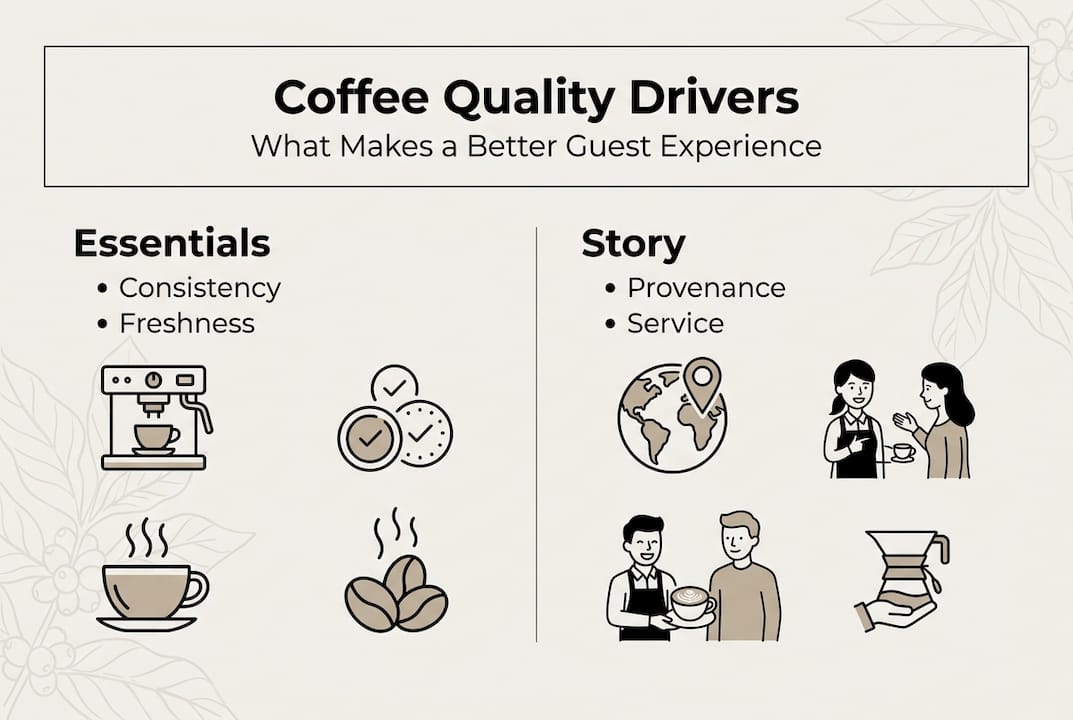
The SCA coffee standards provide a globally recognised framework for evaluating coffee quality. While you do not need to run a cupping lab in your kitchen, understanding these benchmarks helps you ask better questions of your supplier and make more informed purchasing decisions. Consistent quality is achieved through rigorous selection and evaluation processes, and your supplier should be able to demonstrate this.
Here is a quick comparison of quality factors and their relevance to your venue:
| Quality factor | What it means | Why it matters to your business |
|---|---|---|
| Origin and variety | Where the bean comes from | Influences flavour profile and story |
| Roast date | How recently the coffee was roasted | Freshness directly affects taste |
| Brewing precision | Correct dose, grind, temperature | Consistency across your team |
| Staff training | Knowledge and technique | Reduces waste and improves output |
| Equipment condition | Calibrated, clean machinery | Protects flavour and reduces downtime |
To conduct a basic quality audit at your venue, follow these steps:
- Taste your own coffee as a guest would, at different times of day and made by different team members.
- Check your roast dates. If your beans are more than four weeks from roast, freshness is already compromised.
- Review your equipment maintenance log. When was your grinder last calibrated? Your machine last descaled?
- Ask your team what they find difficult about the coffee service. They will tell you where the gaps are.
- Read your recent reviews and note every mention of coffee, positive or negative.
When choosing commercial coffee beans, your supplier should support this audit process, not just deliver bags to your back door.
How coffee quality impacts guest experience and loyalty
With a clear quality framework in mind, let us look at the tangible impact this has on the real-world guest experience.
The evidence is consistent. Venues serving higher-quality coffee receive more positive reviews and higher customer return rates. This is not a coincidence. Coffee appears at emotionally significant moments in the guest journey, and quality at those moments creates positive associations that guests carry with them.
UK diner expectations have risen sharply in recent years. Guests who receive an excellent coffee experience are more likely to mention it unprompted in online reviews, recommend your venue to others, and return sooner.

Coffee also influences spend. Guests who linger over a well-made coffee order more. A second round of drinks, a slice of cake, an extra course. Optimising your coffee service is therefore not just about the margin on the cup itself. It is about what that cup unlocks in the broader transaction.
Consider how coffee touches the guest experience across different venue types:
- Hotels: Morning coffee sets the tone for the day. A poor breakfast brew can overshadow everything else.
- Restaurants: Post-meal coffee is the final flavour memory your guest takes home.
- Cafés: Coffee is the core product. Quality here is non-negotiable.
- Event venues: Delegates judge the whole event partly on the quality of the refreshments.
“Operators who take coffee seriously see measurable improvements in guest satisfaction scores and incremental revenue per visit. It is one of the most cost-effective upgrades available to a hospitality business.” Industry insight, 2025.
Building hospitality coffee expertise into your team and your processes creates a compounding effect. Each positive coffee experience builds on the last, reinforcing your reputation over time.
Practical steps to improve coffee quality in your business
Now that we know why coffee quality matters and how it impacts results, here is how to elevate it in your operations.
- Audit your current offer. Use the steps outlined above to identify your biggest gaps. Is it the beans, the equipment, the training, or the consistency?
- Choose the right supplier. Look for a roaster who offers freshly roasted beans, transparent sourcing, and genuine support. Choosing coffee suppliers wisely enhances both product quality and operational reliability, so do not treat it as a purely transactional decision.
- Invest in staff training. Ongoing barista training and well-maintained equipment are essential for consistent quality. A well-trained team wastes less coffee, serves more confidently, and creates a better guest experience every time.
- Maintain your equipment. Book regular servicing for your espresso machine and grinder. Clean equipment produces better coffee and lasts longer.
- Review your menu. Are you offering the right range? Consider whether your current coffee menu reflects the quality of your beans and the skills of your team.
- Gather feedback. Ask guests directly, monitor online reviews, and create a simple internal tasting routine to track consistency week on week.
A hotel coffee service guide will tell you that equipment and beans matter. But the real differentiator is the combination of all these elements working together, supported by a supplier who understands your business.
Pro Tip: Involve your front-of-house team in the quality conversation. When staff understand why coffee quality matters and feel ownership over it, the results improve noticeably and quickly.
The overlooked power of coffee quality in hospitality
Most operators focus on the margin per cup when they think about coffee. That is understandable, but it misses the bigger picture entirely.
We have seen it repeatedly across the Southwest: venues that treat coffee as a strategic asset, rather than an operational necessity, consistently outperform those that do not. Not just in coffee sales, but in total revenue, average spend, and guest retention. Coffee shapes dwell time. Guests who feel they are being served something genuinely good stay longer, spend more, and come back. That multiplier effect is rarely captured in a simple cost-per-cup calculation.
The uncomfortable truth is that a poor coffee experience can quietly undermine everything else you do well. A beautifully presented dish, a warm welcome, a stunning room. All of it can be diminished by a flat, stale, or bitter cup at the end. Conversely, an exceptional coffee moment can rescue an otherwise average visit and turn it into a positive review.
Building hospitality coffee expertise into your operation is a strategic decision, not just a procurement one. The businesses that understand this are the ones setting the standard in their area.
Enhance your hospitality business with premium coffee solutions
If this article has prompted you to look more critically at your coffee offer, you are already ahead of most. The next step is finding the right partner to help you act on it.
At The Coffee Factory, we work with hospitality and foodservice businesses across Devon, Somerset, Cornwall, and the wider Southwest to deliver freshly roasted coffee, expert barista training, and equipment support tailored to your operation. Our wholesale coffee services are built around consistency, quality, and genuine local partnership. Explore our full range of hospitality coffee solutions and let us help you serve something your guests will remember. Let’s get brewing.
Frequently asked questions
How can coffee quality be measured in a hospitality business?
Coffee quality is benchmarked using SCA grading, regular in-house tastings, and guest feedback. Assess consistency, freshness, and flavour across different team members and service times.
What is the fastest way to improve coffee quality in a hotel or restaurant?
Start with fresher beans, structured staff training, and a scheduled equipment maintenance routine. These three changes deliver the most immediate and noticeable improvement.
Is it worth the cost to invest in higher quality coffee?
Yes. Premium coffee drives better guest satisfaction, stronger reviews, and higher return rates, making it one of the most cost-effective investments available to a hospitality business.
Do guests really notice small improvements in coffee quality?
Absolutely. Customer reviews regularly mention coffee quality as a highlight, and even modest improvements in consistency and flavour can shift the tone of guest feedback meaningfully.