
TL;DR:
- Roasting transforms green beans into flavorful coffee through controlled heat, time, and airflow.
- Different roast levels impact taste, energy use, and environmental footprint, influencing menu and cost.
- Understanding roasting variables and defects allows operators to improve consistency and differentiate their coffee offerings.
Most café owners and hospitality operators assume that bean origin is everything. Choose a great single-origin Ethiopian, pair it with a decent machine, and the coffee sells itself. But that assumption leaves a significant gap. Roasting is the transformative step that either unlocks or destroys the potential in every green bean you buy. Get it wrong and even the finest Yirgacheffe tastes flat, sour, or burnt. Get it right and a well-sourced, expertly roasted blend becomes a genuine revenue driver. This guide will give you a practical understanding of roasting, from the chemistry to the commercial implications, so you can make sharper sourcing decisions and deliver a more consistent guest experience.
Table of Contents
- What is coffee roasting? From green bean to brew
- Roast profiles explained: light, medium, or dark?
- What influences roasting outcomes? Key variables for quality and consistency
- Roast defects that matter for your menu
- From theory to menu: Applying roasting knowledge in your business
- Our perspective: Why mastering roasting knowledge sets hospitality apart
- Enhance your coffee offering: Expert support for the Southwest UK
- Frequently asked questions
Key Takeaways
| Point | Details |
|---|---|
| Roasting shapes flavour | The way coffee is roasted defines its taste, aroma, and how well it fits your menu. |
| Light roasts maximise yield | Choosing light roast coffee can enhance margins and lower environmental impact without sacrificing quality. |
| Defects reveal bigger issues | Common roast problems often indicate wider supply or process issues—address them early to maintain consistency. |
| Supplier conversations matter | Work closely with suppliers to specify preferred roast profiles and quality controls that align with your business goals. |
| Applied roasting boosts business | Translating roasting knowledge into menu planning and staff training earns customer loyalty and sets you apart. |
What is coffee roasting? From green bean to brew
Coffee roasting is the process of applying heat to raw green beans to trigger the chemical reactions that create the flavours, aromas, and body we associate with a great cup. Green beans are essentially inert. They carry the genetic potential of the variety and the terroir of the farm, but none of the taste. Roasting is what brings them to life.
The process moves through three broad stages. Drying removes moisture from the bean, which can contain up to 12% water content. Browning begins the Maillard reaction, developing hundreds of flavour compounds and shifting the bean from yellow to light brown. Development is the final and most critical stage, where the roaster controls how far the bean transforms, locking in the intended flavour profile.
Three core variables shape every roast:
- Temperature controls how fast and how far the bean develops
- Time determines how long each stage lasts, affecting sweetness, acidity, and body
- Airflow manages heat transfer and removes chaff, influencing evenness and clarity of flavour
When any of these fall out of balance, defects occur. Common roast defects include scorching, tipping, baking, underdevelopment, and overdevelopment, each tied directly to heat application and airflow errors. For hospitality operators, defects are not just a quality issue. They translate to inconsistent cups, customer complaints, and wasted product.
Consistency is the real prize here. When you are choosing commercial beans for your venue, understanding roasting consistency helps you ask the right questions of any supplier and protect your menu’s repeatability.
Roast profiles explained: light, medium, or dark?
Roast levels are often treated as a simple matter of taste preference. In reality, they carry significant business implications that operators frequently overlook.
| Roast level | Taste profile | Visual | Business pros | Business cons |
|---|---|---|---|---|
| Light | Bright, acidic, complex, fruity | Pale brown, no oil | Higher yield, lower energy | Requires skilled brewing, niche appeal |
| Medium | Balanced, sweet, rounded | Mid-brown, slight sheen | Broad appeal, versatile menu | Less differentiation |
| Dark | Bold, bitter, low acidity | Dark brown, oily surface | Familiar to mass market | Lower yield, higher energy cost |
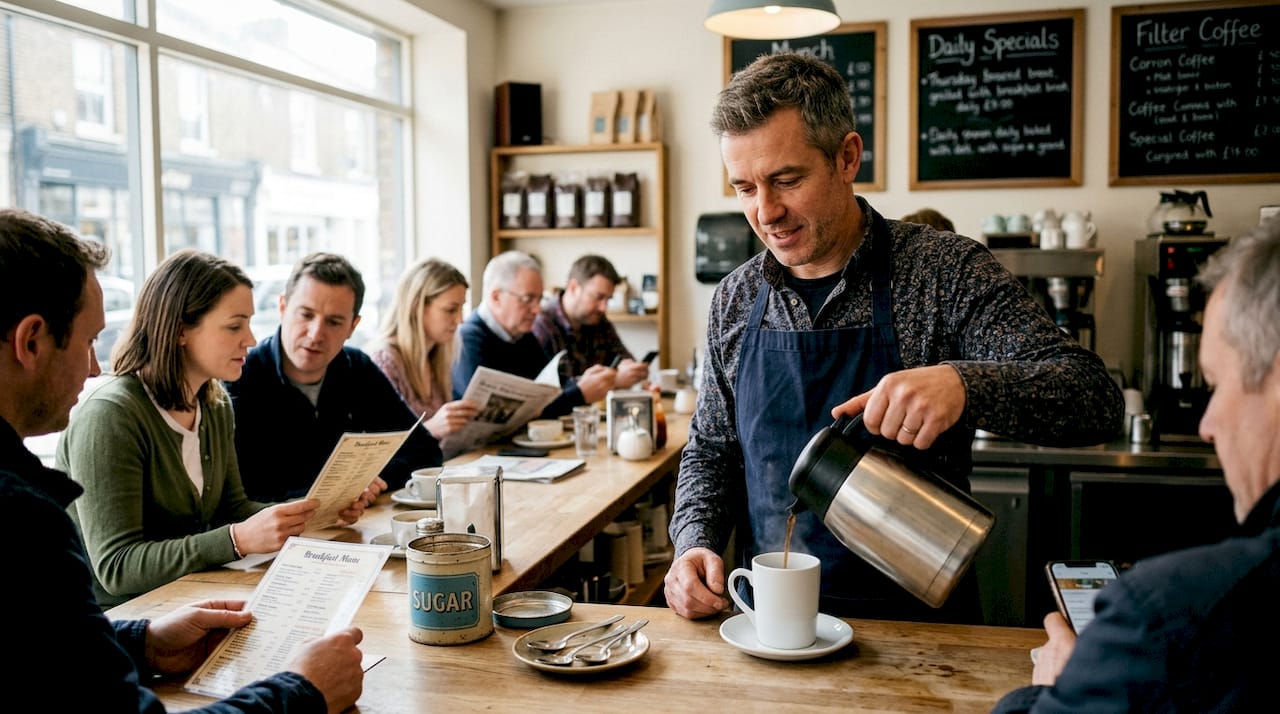
A medium roast is the workhorse of most café breakfast menus. It suits a wide range of brewing methods and customer palates, making it a safe anchor for your core espresso or filter offering. A light roast example shows how fruity, tea-like qualities can appeal to specialty coffee drinkers, making it ideal for seasonal specials or a premium menu tier.
The environmental and cost picture is equally important. Energy consumption and emissions vary meaningfully by roast level: light roast uses approximately 1.75 kWh per 5 kg batch with 0.525 kg of CO2, medium uses 2.1 kWh and 0.63 kg, and dark uses 2.625 kWh and 0.79 kg. CO2 emissions fall by roughly a third when comparing light to dark. For venues with sustainability commitments, this is a compelling reason to explore lighter profiles.
Pro Tip: Match your roast profile to your audience before your menu. A hotel breakfast crowd often wants familiarity and body, favouring medium to dark. A specialty café audience may reward you for a well-sourced light roast on your seasonal coffee specials. The smartest venues use data-driven roasting insight to make this decision with evidence, not guesswork.
What influences roasting outcomes? Key variables for quality and consistency
Knowing the roast levels is one thing. Understanding what shapes them is where operators gain a real edge when speaking to suppliers.
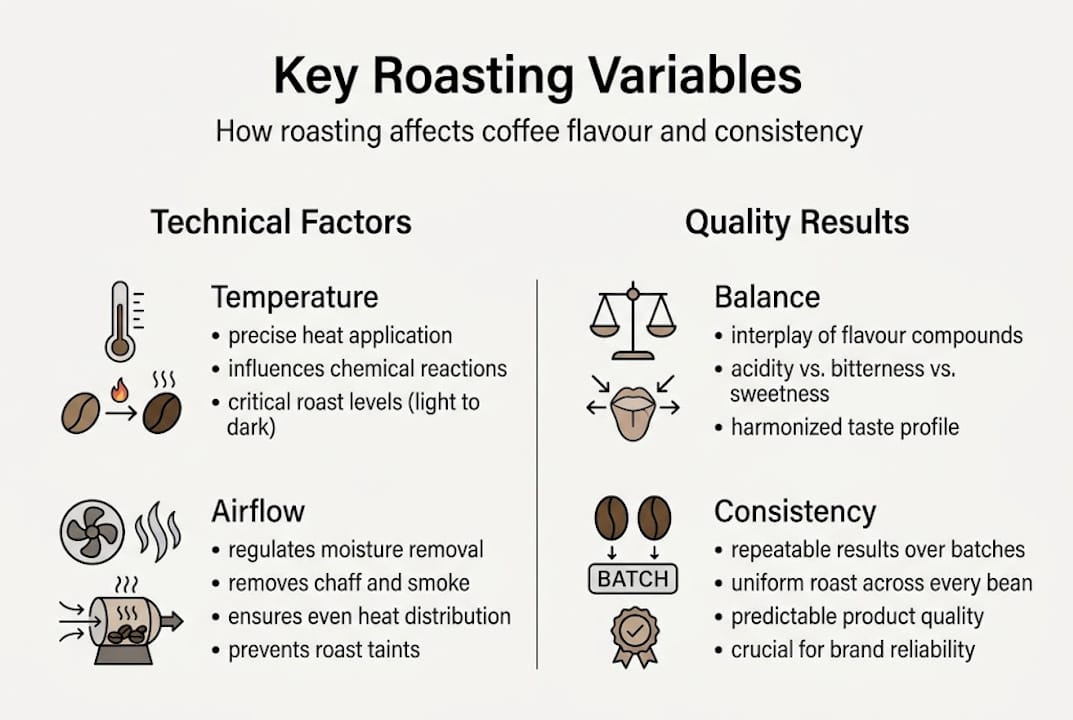
Three technical factors govern roasting outcomes:
Rate of Rise (RoR) is the speed at which bean temperature increases during roasting. A declining RoR through the development phase is the hallmark of a controlled, intentional roast. An erratic RoR often produces baked or underdeveloped coffee.
Airflow removes moisture and chaff while regulating heat transfer. Too little airflow causes smoky, harsh flavours. Too much strips delicate aromatics before they can develop.
Batch size affects how heat moves through the drum. Overfilling reduces consistency; underfilling accelerates development unpredictably.
A reputable roaster follows a structured quality process:
- Profile the green bean before roasting, noting density, moisture, and processing method
- Set a target development time ratio, typically 20 to 25% of total roast time
- Monitor RoR in real time and adjust heat and airflow accordingly
- Cup the batch against a reference profile before releasing to clients
- Log every variable so the roast is fully repeatable
“Investing in robust, data-driven roasting processes is not just about quality. It is about protecting your menu, your margins, and your reputation with every single batch.”
When improving coffee quality at your venue, ask your supplier directly about their profiling and logging practices. Roast defects often reveal weaknesses in sourcing or equipment, as lighter roasts yield more and produce fewer emissions, meaning a supplier who defaults to dark roasting may be masking inconsistency. When choosing coffee suppliers, these are the questions that separate a genuine craft roastery from a commodity operation.
Roast defects that matter for your menu
Defects are the hidden enemy of a consistent coffee menu. They often go undetected until a customer complains, a review appears, or your barista notices something is off. Knowing what to look for puts you in control.
| Defect | Cause | What customers taste |
|---|---|---|
| Scorching | Excessive heat at start of roast | Harsh, acrid, ashy bitterness |
| Tipping | Rapid heat application, bean tips burn | Papery, woody, unpleasant aftertaste |
| Baking | Too slow, insufficient heat | Dull, flat, cardboard-like flavour |
| Underdevelopment | Roast ended too early | Sour, grassy, sharp acidity |
| Overdevelopment | Roast pushed too far | Bitter, smoky, one-dimensional |
Roast defect identifiers are well-established: scorching presents as burnt patches on the bean surface, baking produces a dull flat flavour, underdevelopment yields sourness, and overdevelopment results in persistent bitterness.
Common causes and quality checks to apply:
- Request a sample roast before committing to a new supplier
- Brew a cupping session with your team to assess against a known reference
- Check for visual uniformity across the batch, uneven colour signals inconsistency
- Ask your supplier for their defect rate and quality control log
Pro Tip: Train at least one member of staff to cup coffee weekly. It takes 30 minutes and gives you early warning before defects reach your guests. This is especially important when you introduce new hospitality coffee equipment, as machine calibration can interact with roast profile in unexpected ways.
Defects have a direct cost. Wasted product, rebrewing, and lost customer confidence all erode margin. If defects appear repeatedly, it is time to revisit your supplier relationship or your equipment calibration.
From theory to menu: Applying roasting knowledge in your business
Understanding roasting is only useful if it changes how you operate. Here is how to translate this knowledge into practical improvements across your venue.
Working effectively with your supplier on roast specifications:
- Share your menu format and brewing methods so they can tailor the roast accordingly
- Request traceability data including farm origin, processing method, and roast date
- Ask for a development time ratio and RoR log for your regular blend
- Set a review schedule, quarterly at minimum, to assess consistency and explore new profiles
- Agree on a maximum acceptable time between roast date and delivery to preserve freshness
Staff training is the bridge between supplier quality and guest experience. When your team understands the difference between a baked and an underdeveloped cup, they can catch issues before they reach the table. Brief tastings during pre-shift briefings build this literacy quickly and affordably.
Roast data also opens coffee menu ideas that competitors simply cannot replicate. Imagine promoting a seasonal single-origin with a specific roast profile and development ratio on your menu board. That level of detail signals craft, builds trust, and justifies a premium price point.
Defects rooted in poor data management are avoidable when suppliers invest in robust profiling systems. Choosing a roastery that logs and shares this data gives you a genuine competitive advantage in menu differentiation and profitable coffee service. Lighter, well-profiled roasts also improve your environmental credentials, which increasingly matters to guests and corporate clients alike.
Our perspective: Why mastering roasting knowledge sets hospitality apart
In our experience, most venue owners focus their energy on two things: which beans to buy and which machine to install. Both matter. But neither is the true differentiator. The operators who consistently earn loyal regulars and strong reviews are the ones who understand what happens between the farm and the cup.
Roasting literacy changes the conversation you have with your supplier. Instead of accepting whatever arrives in the bag, you can specify, question, and collaborate. That shift alone reduces menu complaints, tightens cost control, and builds staff confidence in a way that no equipment upgrade can replicate.
We have seen venues transform their coffee reputation simply by asking better questions and acting on the answers. The venues that embrace a data-driven roasting approach are in the minority. That is precisely why those that do stand apart. Roasting knowledge is not just for roasters. It is the hospitality professional’s most underused tool.
Enhance your coffee offering: Expert support for the Southwest UK
Putting roasting knowledge into practice is far easier when you have the right partner alongside you. At The Coffee Factory, we roast to order for hospitality and foodservice businesses across Devon and the wider Southwest, ensuring every delivery is fresh, consistent, and tailored to your menu.
Our wholesale coffee services include roast profile consultation, menu support, and flexible supply contracts built around your operation. We also offer specialist decaffeinated wholesale options for venues serving a broad audience, and on-site barista training to make sure your team can deliver every cup with confidence. Let’s get brewing together.
Frequently asked questions
What are the main stages of coffee roasting?
Drying, browning, and development: each transforms the green bean into a flavourful coffee that matches your desired profile. Every stage must be controlled carefully to avoid defects and achieve consistency.
How does roast level affect café profitability?
Lighter roasts use less energy and produce a higher bean yield with lower CO2 emissions compared to darker profiles, which directly improves your cost per cup and environmental standing.
What causes bitter or sour coffee in my venue?
Overdevelopment results in bitterness while underdevelopment yields sour notes, and both are typically rooted in roasting error or inconsistent supplier quality control.
Can I request specific roast profiles from my supplier?
Yes, reputable suppliers should offer custom roast options, full transparency on their profiling data, and the flexibility to adapt to your menu and customer base.